
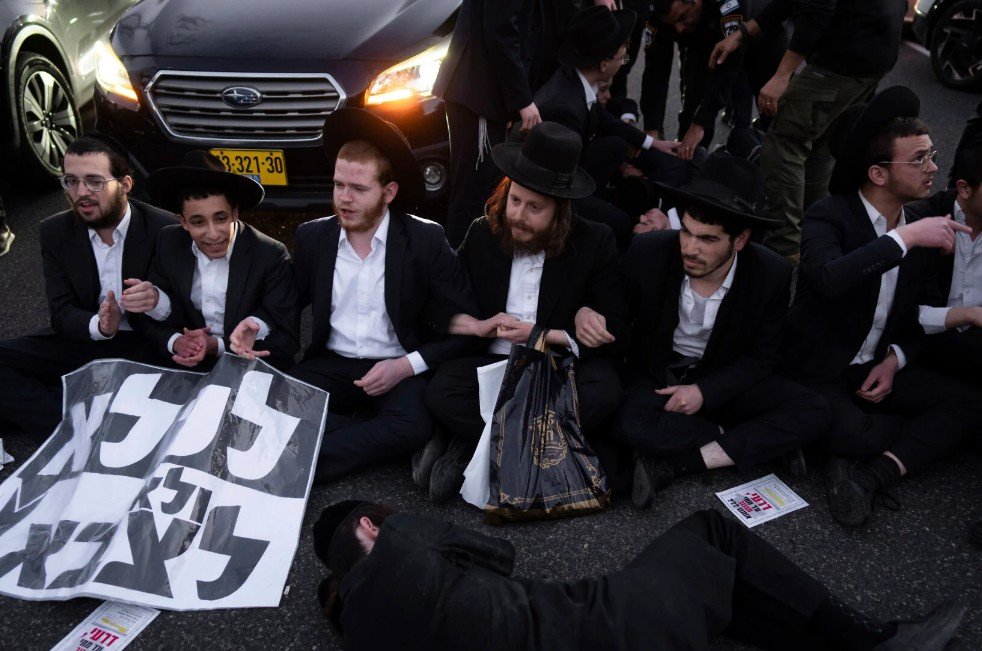
Dozens of ultra-Orthodox Jews shut down a major roadway near Tel Aviv on Monday evening, protesting the arrest of a draft evader from their community. The demonstration, brief but tense, underscored how Israel’s long-simmering battle over compulsory military service keeps spilling into public space, often at rush hour, often without warning.
Traffic stalled. Tempers flared. And the deeper argument, again, refused to stay quiet.
Highway 4 Blockade Brings Gush Dan Traffic to a Halt
The protest unfolded on Highway 4, one of the busiest arteries in the Tel Aviv metropolitan area, according to Israeli media reports cited by Anadolu Agency.
Demonstrators, identified as members of the ultra-Orthodox, or Haredi, community, blocked lanes during the evening hours, disrupting traffic across parts of Gush Dan. Police were deployed quickly, though clashes were limited compared with earlier protests this year.
For commuters, the scene was familiar. Cars stopped. Drivers waited. Sirens echoed.
Channel 12 reported that the protest was sparked by the arrest of a draft evader earlier in the day, an incident that rapidly escalated into confrontation.
Arrest That Triggered the Protest
According to the report, the detained man had attempted to evade military service and was arrested by military police.
As officers tried to remove him, protesters reportedly rushed the scene. In the chaos, the suspect briefly escaped custody with help from demonstrators, and a police vehicle was overturned during the confrontation.
That moment became the rallying cry.
Within hours, protesters regrouped near Tel Aviv, choosing Highway 4 for maximum visibility. Blocking roads has become a go-to tactic, one that guarantees attention even when numbers are small.
One sentence says it plainly. A single arrest can shut down a city.
Why the Draft Still Divides Israeli Society
Military service in Israel is compulsory for most citizens, men and women alike, beginning at age 18.
That obligation sits at the heart of a decades-long dispute between the state and the ultra-Orthodox community. Haredim argue that army service threatens their religious way of life, disrupting Torah study and weakening tightly knit social structures built around faith.
Prominent rabbis have repeatedly urged followers to resist enlistment. Some have gone further, publicly calling on young men to tear up draft notices.
This stance puts them at odds with much of the broader public, where military service is widely seen as both a civic duty and a shared burden.
The tension never really disappears. It just waits for the next spark.
A Long History of Deferments and Exemptions
For decades, most ultra-Orthodox men avoided service through repeated deferments granted for full-time religious study.
Those deferments allowed many to delay enlistment year after year until reaching the exemption age, currently set at 26. The arrangement, informal at first, gradually hardened into policy.
Critics say the system created inequality. Supporters say it preserved a vital religious community.
Recent court rulings and political pressure have pushed the government to tighten enforcement, leading to arrests like the one that triggered Monday’s protest.
That shift has made confrontations more frequent, and more volatile.
Police Response and Public Order Concerns
Police units moved to secure the area around the blockade and reopen the highway.
While officers avoided large-scale force, the presence of overturned vehicles earlier in the day raised alarms within law enforcement. Blocking major roads, especially in central Israel, carries risks that go beyond inconvenience, including delayed emergency response and heightened chances of violence.
Officials have warned repeatedly that protests crossing into infrastructure sabotage will be met with firmer action.
Still, enforcement remains tricky. Each arrest risks triggering the next demonstration.
It’s a cycle everyone recognizes, even if no one seems able to stop it.
The Numbers Behind the Debate
Ultra-Orthodox Jews make up roughly 13% of Israel’s population, which stands at about 10 million.
That share is growing faster than any other demographic group in the country, adding urgency to the draft debate. As numbers rise, so does the pressure on the military and the political system to settle the issue more permanently.
Here’s a snapshot of the core tension:
| Issue | Broader Israeli View | Haredi Community View |
|---|---|---|
| Military service | Shared civic duty | Threat to religious life |
| Draft enforcement | Necessary equality | State overreach |
| Torah study | Important, but not exempting | Central life mission |
Those positions have barely moved over time.
A Protest That Reflects a Bigger Struggle
Monday’s blockade near Tel Aviv was small compared with some earlier demonstrations, but its message was loud.
For the Haredi protesters, the arrest symbolized a line crossed by the state. For many secular and religious Israelis outside the ultra-Orthodox community, the protest symbolized refusal to share responsibility.
Both sides feel wronged.
And until there’s a political compromise that sticks, highways, light rail lines, and city centers will likely keep becoming stages for this argument.
By night’s end, Highway 4 reopened. Traffic flowed again. But the dispute that caused the shutdown is still very much in place, waiting for the next flashpoint.
