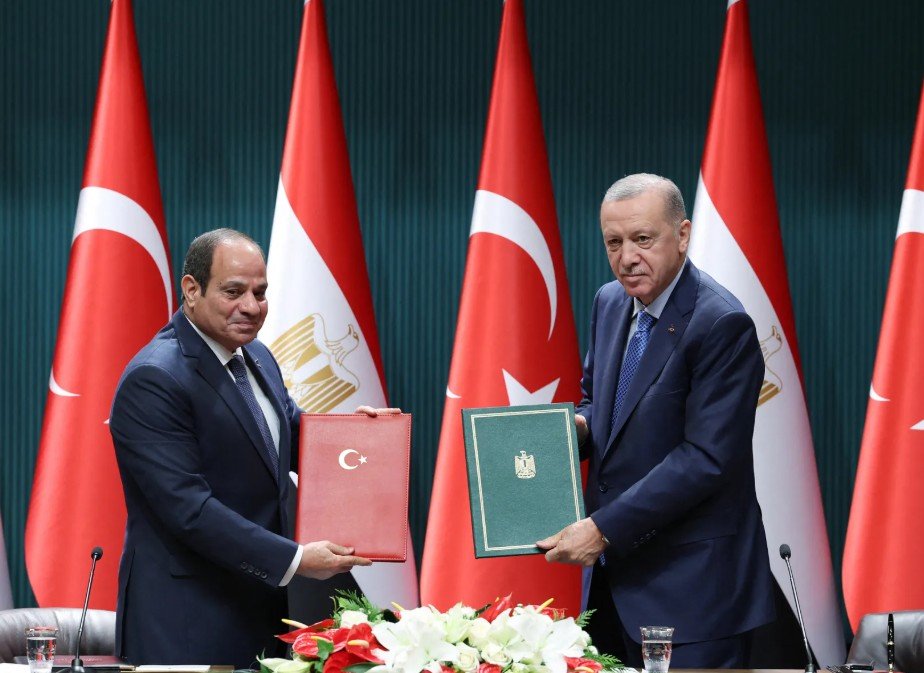
Two major power players in the Middle East are shaking hands again after a decade of silence. The recent high level meetings between Turkish President Recep Tayyip Erdogan and Egyptian President Abdel Fattah el-Sisi mark a massive shift in the geopolitical map. This isn’t just a photo opportunity for the cameras. It is a necessary survival strategy for both nations as the region faces unprecedented chaos.
The Eastern Mediterranean and the Red Sea are currently reshaping the global security order. Wars are raging in Gaza and Sudan while trade routes face daily attacks. Ankara and Cairo realized they can no longer afford to be rivals. The fractures in the region are forcing them to build a new wall of security together.
Turning a New Page in Diplomatic Relations
The relationship between Turkey and Egypt hit rock bottom in 2013. For years, the two nations stood on opposite sides of almost every regional conflict. But the ice has finally melted. The recent visits exchanged between the leaders in Cairo and Ankara signaled the official end of the cold war.
Both leaders have signed a joint declaration to restructure the High-Level Strategic Cooperation Council. This move elevates their relationship from cautious neighbors to strategic partners.
The driving force behind this reunion is pragmatism. Both countries face severe economic headwinds and security threats that ignore borders. They understand that a unified front is stronger than solitary struggles.
Key areas of the new cooperation include:
- Political Coordination: Regular meetings to align stances on international issues.
- Regional Stability: Working together to cool down hotspots like Libya and Sudan.
- Counter-terrorism: Intelligence sharing to secure border areas.
This diplomatic reset is changing the calculus for other players in the region. Countries that used to play one side against the other now have to deal with a united Ankara-Cairo axis.
Boosting Trade Volume and Defense Deals
Money is a major motivator in this renewed friendship. Both nations are eager to fix their economies. During their recent summits, the leaders set an ambitious goal to increase trade volume to $15 billion in the near future.
Turkish companies are already big investors in Egypt. They employ over 100,000 Egyptians and export goods worth billions. Now, the gates are open for even more investment.
The energy sector is particularly promising. Turkey needs energy security, and Egypt wants to export its Liquefied Natural Gas (LNG). They are exploring new ways to ship Egyptian gas to Europe via Turkey.
Defense is another pillar of this new alliance. Egypt has shown serious interest in Turkish military technology.
This potential defense cooperation scares some adversaries but comforts allies. A well-equipped Egyptian military backed by Turkish tech creates a formidable barrier against instability.
Red Sea Security and the Gaza War Impact
The war in Gaza has spilled over into the Red Sea. This corridor is the lifeline for the global economy and specifically for Egypt’s Suez Canal.
Houthi attacks on commercial ships have forced major shipping lines to divert around Africa. This bypass costs Egypt millions of dollars every month in lost canal transit fees.
Turkey is also suffering. The disruption in the Red Sea hurts Turkish exports to Asia and the Gulf. Both nations have a shared interest in securing these waters.
The Gaza crisis connects them emotionally and politically:
- Humanitarian Aid: Both nations are coordinating efforts to get food and medicine into Gaza.
- Rejection of Displacement: Ankara supports Cairo’s firm stance against forcing Palestinians into the Sinai Peninsula.
- Political Solution: They agree that a two-state solution is the only path to long term peace.
Israel’s military actions near the Rafah border have alarmed Cairo. Egypt fears that a total collapse of order in Gaza could push militant groups into its territory. Turkey stands firmly with Egypt on this red line, offering diplomatic weight to Cairo’s warnings.
United Front in Somalia and Libya
The alliance extends beyond their immediate borders. In North Africa and the Horn of Africa, Turkey and Egypt are aligning their compasses.
Libya was once the biggest point of contention between them. Turkey supported the government in Tripoli, while Egypt backed forces in the east. Now, they are coordinating to support a unified political process. They want a stable Libya that doesn’t export weapons or refugees.
The situation in the Horn of Africa is equally volatile. Ethiopia’s recent deal with the breakaway region of Somaliland sparked anger in Somalia.
Both Turkey and Egypt have stepped up to support Somalia’s territorial integrity. Egypt recently signed a defense pact with Somalia and sent military aid. Turkey has a long standing military base in Mogadishu and trains Somali troops.
Together, they are sending a clear message to Ethiopia. They will not accept changes to borders that threaten regional stability. This coordination prevents a power vacuum that could be exploited by other global powers.
The Ankara-Cairo rapprochement is the most significant diplomatic development of the year. It transforms the Eastern Mediterranean from a zone of competition into a potential hub of cooperation. While challenges remain, the willingness of Erdogan and Sisi to work together offers a glimmer of hope. They are reshaping the East Med-Red Sea corridor into a fortress of stability in a world that feels increasingly fragile.