
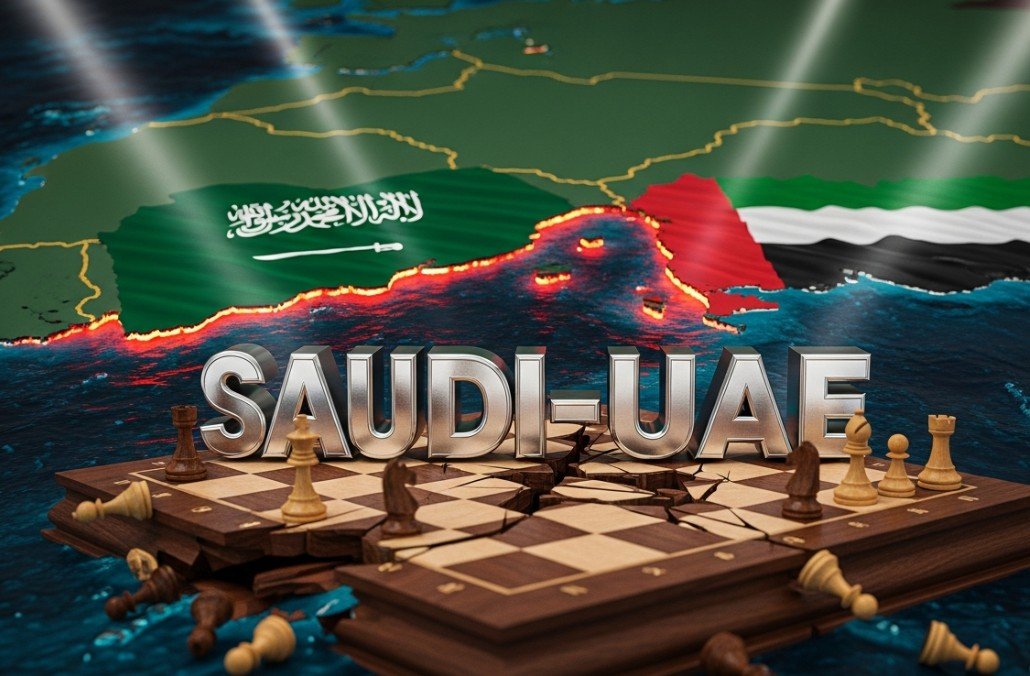
Tensions between Saudi Arabia and the United Arab Emirates have escalated into one of the most consequential rifts in Middle East politics in decades, eroding the longstanding perception that the two Gulf powers formed a stable strategic bloc. A once-touted alliance against regional threats is now unraveling, reshaping Yemen’s civil war, unsettling regional diplomacy, and unsettling business and security dynamics across the region.
As divisions widen, both capitals are charting diverging paths that could weaken collective Gulf influence, complicate counter-Iran efforts, and create strategic vacuums Western policymakers had hoped to prevent.
Rival Visions for Regional Order
For years, Western officials assumed Saudi Arabia and the UAE acted in coordination as the Gulf’s security anchors against Iranian influence and militia proxies, particularly in Yemen. That assumption has disintegrated. Analysts now describe a “cold war” between Riyadh and Abu Dhabi fueled by fundamentally incompatible goals and strategic approaches.
Saudi Arabia, under Crown Prince Mohammed bin Salman, has increasingly prioritized territorial order, border stability, and integration of Yemen under a centralized government aligned with Riyadh’s interests. The kingdom views political fragmentation and separatist gains in Yemen as direct threats to its national security, particularly along its long southern frontier.
The UAE, by contrast, has focused on extending influence through coastal and port networks, local proxies, and flexible engagement in fragile states. This strategy places heavy emphasis on access, maneuverability, and building long-term footholds via local actors like the Southern Transitional Council (STC) in Yemen.
These competing priorities have transformed a once cooperative relationship into a rivalry with potentially wide-ranging consequences for stability across the Red Sea corridor and the Gulf Cooperation Council collectively.
Yemen Becomes a Fault Line
The divergent approaches of Riyadh and Abu Dhabi have manifested most visibly in Yemen, where the protracted civil conflict has morphed into a proxy arena for Gulf competition. Initially, both countries joined a Saudi-led coalition in 2015 to counter the Iran-aligned Houthi movement. But their objectives diverged sharply over time.
In late 2025, the UAE-backed Southern Transitional Council launched a major offensive in the south and east of Yemen, seizing large swaths of territory including Hadhramaut and al-Mahrah — areas seen by Saudi strategists as vital to containing threats near their border.
Saudi Arabia responded with a forceful counteroffensive, including air strikes on STC positions and a rapid advance by Yemeni government forces allied with Riyadh. The counterattack recaptured key cities, including Aden, leading to the reported dissolution of the STC in January 2026 and the flight of its leader to the UAE.
The clash revealed not just tactical differences but strategic divergence. Riyadh views a unified Yemeni state, under formal government authority, as essential to Gulf security, while Abu Dhabi’s support for separatist forces aimed to build long-term influence along strategic maritime routes. This contradiction has strained bilateral cooperation and undercut the coherence of Gulf intervention strategies.
Business and Diplomatic Fallout
The Gulf rivalry is spilling beyond battlefields and into diplomacy and commerce. Saudi-UAE relations have visibly cooled, with Saudi media and commentators increasingly critical of Abu Dhabi’s policy choices.
In the business sphere, firms operating in the UAE report disruptions tied to the growing rift. Companies, including banks and consultancies, have experienced Saudi visa challenges for employees — a development some interpret as a pressure tactic in the broader geopolitical contest. Emirates-based businesses are seeking alternative routes via neighboring countries to maintain operations.
These tensions also influence wider Gulf diplomacy. Countries like Egypt appear to be aligning more with Saudi perspectives on regional stability issues, highlighting Abu Dhabi’s growing isolation on some matters, including the trajectory of Yemen’s future.
Europe and other global partners are also taking note. Analysts warn that a fractured Saudi-UAE axis complicates European interests in the Red Sea and may pressure Western diplomatic strategies, which had counted on a unified Gulf posture.
Strategic Implications and Regional Risk
Beyond immediate diplomatic splits and battlefield tensions, the Saudi-UAE rift carries deeper implications for Middle East geopolitics. By dismantling the illusion of a cohesive Gulf front, the rivalry inadvertently loosens the framework that had constrained Iranian influence and militia leverage in conflicts like Yemen.
The fragmentation contributes to security vacuums in volatile regions stretching from Yemen to the Horn of Africa, where parallel alliances and external actors — including Israel, Qatar, and Turkey — increasingly factor into the strategic calculus.
Some experts caution that continued competition without effective conflict management mechanisms could embolden local non-state actors and increase the risk of broader confrontation, especially as external powers weigh their roles in the evolving regional balance.
Saudi Arabia’s insistence on internal Yemeni unity and the UAE’s preference for localized influence present a stark example of how Gulf states’ differing philosophies can have cascading effects on peace, security, and governance in the wider Middle East.
The outcome of this competition will shape not only Yemen’s future but the stability of sea lanes, migratory corridors, and diplomatic alignments across the Red Sea and Gulf Cooperation Council regions for years to come.
