Saudi Arabia’s quiet talks over China’s JF-17 fighter are less about filling an urgent military gap and more about sending a message. Riyadh is signaling that it wants options, flexibility, and leverage as US security guarantees grow more conditional and politically tangled.
Saudi Arabia’s reported interest in converting financial support for Pakistan into a potential fighter jet deal highlights how Gulf arms buying is now shaped by hedging and alliance math, rather than raw battlefield needs.
A loan conversion that says more than it seems
At the center of the talks is a proposal to convert roughly US$2 billion in Saudi loans to Pakistan into a deal for JF-17 Thunder fighter jets.
The aircraft is a light combat fighter jointly developed by Pakistan and China and produced at the Pakistan Aeronautical Complex.
The broader package could reach about $4 billion once weapons, training, and support gear are included, according to multiple reports.
Neither Riyadh nor Islamabad has formally confirmed the negotiations, which is telling in itself.
For Pakistan, the logic is straightforward. Converting debt into defense sales eases financial pressure while locking in a powerful Gulf backer. It also keeps production lines busy at a time when export orders matter more than ever.
For Saudi Arabia, the calculus is more layered.
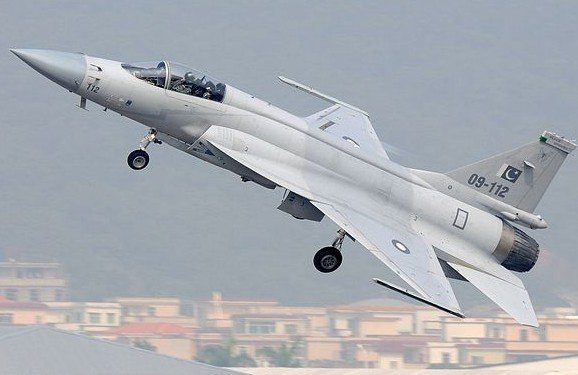
The JF-17 as a political signal, not a frontline replacement
The JF-17 is not meant to replace Saudi Arabia’s frontline fighters.
Riyadh already operates advanced US-made F-15 variants and is awaiting delivery of Eurofighter Typhoons, aircraft that far outperform the JF-17 in range, payload, and sensor fusion.
So why even consider it?
Because procurement choices double as diplomatic tools.
The JF-17 offers a low-cost, relatively simple platform that can be used for training, secondary missions, or partner force development. But its real value lies in what it represents.
It tells Washington that Saudi Arabia has alternatives.
It tells Beijing that Riyadh is open to deeper defense ties.
And it tells Islamabad that loyalty still pays dividends.
Friction with Washington keeps adding up
Saudi Arabia’s relationship with the United States has become more transactional and, frankly, more unpredictable.
Congressional scrutiny over arms sales has increased, especially around Yemen, human rights, and civilian harm concerns.
US export controls also place limits on how American systems can be used, upgraded, or transferred. That creates headaches for long-term force planning.
In recent years, Saudi officials have grown weary of what they see as shifting red lines and political strings attached to defense cooperation.
The JF-17, with Chinese backing, comes with fewer such conditions.
That does not mean Riyadh is turning away from Washington. Far from it.
But it does mean Saudi Arabia wants leverage when negotiations over advanced systems, spare parts, or upgrades hit political roadblocks.
China’s growing comfort in Gulf defense markets
Beijing has been steadily expanding its footprint in the Middle East defense space.
From armed drones to missile technology, Chinese systems have found buyers willing to trade top-tier performance for speed, price, and political flexibility.
The JF-17 fits neatly into this pattern.
It uses a mix of Chinese avionics and weapons, along with some Western-origin subsystems depending on configuration. That hybrid nature makes it attractive to countries that want capability without full dependence on a single supplier.
For China, a Saudi deal would be symbolic.
Selling fighters to one of Washington’s closest Middle Eastern partners would mark a quiet but meaningful shift in regional defense dynamics.
It would also validate Beijing’s long-term bet that US partners will eventually diversify, whether Washington likes it or not.
Pakistan’s role as the bridge
Pakistan sits at the center of this triangle.
It has deep military ties with Saudi Arabia, built over decades of training missions, security cooperation, and financial support.
At the same time, Pakistan is China’s closest strategic partner, especially in defense production.
The JF-17 is the most visible outcome of that partnership.
By offering the aircraft to Saudi Arabia, Pakistan positions itself as a facilitator rather than just a buyer or borrower.
That matters for Islamabad’s standing in the Gulf, particularly as competition for Saudi favor intensifies among Muslim-majority states.
There is also a practical angle.
A Saudi order could help stabilize Pakistan’s aerospace sector at a moment when export revenue is badly needed.
What the JF-17 actually brings to the table
The JF-17 is a lightweight, single-engine multirole fighter designed for affordability and ease of maintenance.
It cannot compete head-to-head with fifth-generation jets or even top-tier fourth-generation fighters.
But it does offer a few practical advantages:
-
Lower acquisition and operating costs compared with Western fighters
-
Compatibility with a range of Chinese air-to-air and air-to-ground weapons
-
Flexibility for training, patrol, and secondary combat roles
For Saudi Arabia, these features are useful on the margins.
They free up high-end platforms for priority missions while expanding overall fleet depth.
A hedge, not a pivot
It would be a mistake to read the JF-17 talks as a Saudi pivot away from the United States.
Riyadh still relies heavily on US intelligence sharing, missile defense cooperation, and integrated command systems.
Those ties are not easily replaced.
But the talks do underscore a shift in mindset.
Saudi Arabia no longer wants to be boxed into a single security provider.
Instead, it is building optionality, quietly and incrementally.
That approach mirrors Saudi moves in energy, diplomacy, and trade, where diversification has become a guiding principle.
What comes next
Much remains uncertain.
The talks could stall. Political pressure could intervene. Or the deal could be reshaped into something smaller, like training aircraft or joint exercises.
Even so, the signal has already been sent.
Saudi Arabia is testing the boundaries of its traditional alliances, and it is doing so with calculated restraint.