
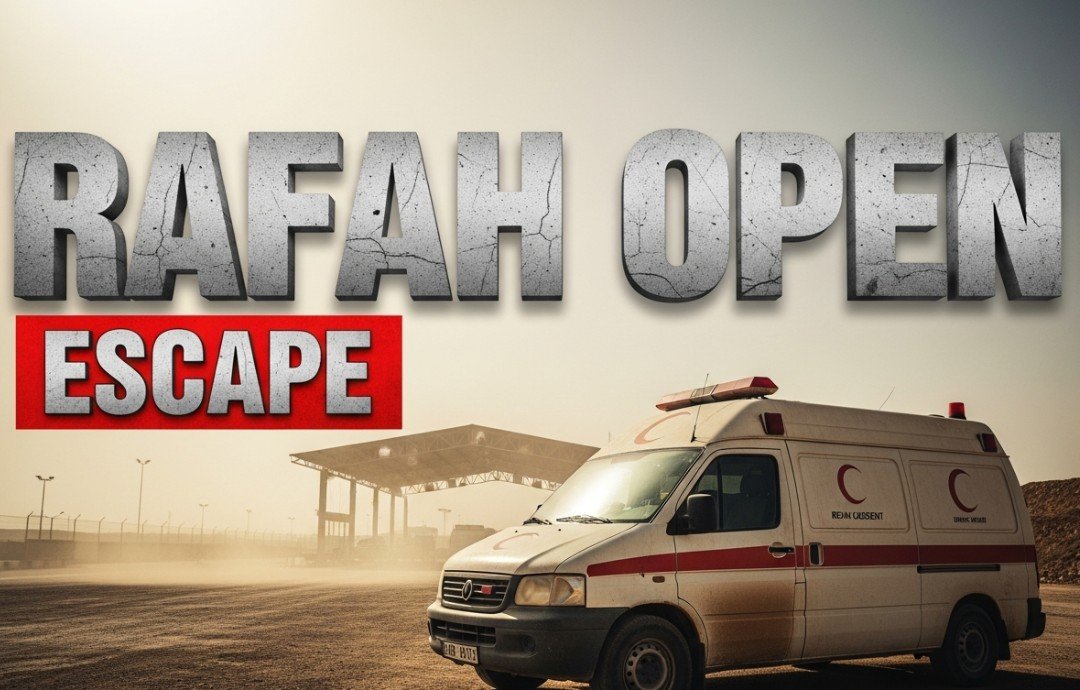
A fragile lifeline emerged at the southern edge of the Gaza Strip on Sunday as the Rafah crossing swung open after days of paralyzed silence. A small convoy of ambulances and buses ferried a handful of critically injured Palestinian patients into Egypt, marking a rare moment of movement in a war that has otherwise sealed the enclave shut. This development comes as international mediators intensify efforts to secure a lasting ceasefire between Israel and Hamas.
The reopening follows a tense 48 hour closure enforced by Israeli authorities on Friday and Saturday. It serves as a grim test of logistical viability for the broader truce agreements currently under negotiation. While the movement of patients offers a glimmer of hope, aid officials warn that the pace is agonizingly slow compared to the catastrophe unfolding just a few miles north of the border.
Medical Evacuees Cross Rafah Border Into Egypt For Lifesaving Care
The scene at the border terminal was a mix of relief and crushing anxiety. According to the Palestinian Red Crescent, exactly 17 medical evacuees along with 27 companions managed to cross into Egypt on Sunday. These patients are part of a staggering backlog of desperate cases that local hospitals can no longer treat due to the total collapse of Gaza’s healthcare infrastructure.
Egyptian state media confirmed the arrival of the group, broadcasting footage of exhausted families disembarking on the Egyptian side. The transfer of these patients was cited as a primary requirement for the ongoing ceasefire talks backed by the United States.
However, the flow of people remains strictly controlled. The United Nations reports that over the first four days of the crossing’s sporadic operation, only 36 patients were permitted to leave. This figure stands in stark contrast to the thousands waiting for permission.
- Current Evacuation Statistics:
- Evacuated Sunday: 17 Patients / 27 Companions
- Total (4 Days): 36 Patients / 62 Companions
- Pending Approval: Approximately 20,000 cases
Witnesses described invasive security measures. Palestinians returning to Gaza during this window reported facing hours of delays. They were subjected to rigorous searches by Israeli authorities and members of Abu Shabab, an Israeli-backed Palestinian armed group operating at the checkpoints. Israel has denied allegations of mistreatment during these screenings.
Families Endure Agonizing Delays And Uncertainty At Gaza Crossing
Behind the statistics lie harrowing stories of families torn between hope and bureaucracy. The selection process for who gets to leave is opaque and often heartbreaking for those left behind.
Amjad Abu Jedian, a young man critically injured during the conflict, was scheduled to cross on the very first day the border reopened. His mother, Raja Abu Jedian, described the devastation of being turned away at the last moment. Amjad was shot by a sniper while performing construction work in the Bureij refugee camp in July 2024.
“We want them to take care of the patients during their evacuation,” Raja pleaded, her voice trembling with exhaustion. “We want the Israeli military not to burden them.”
The family had received a direct call from the World Health Organization (WHO) on Saturday, instructing them to be ready for travel on Sunday. Such calls often come with only hours of notice, forcing injured patients to scramble for transport to the border zone.
For Amjad and hundreds like him, the crossing represents the only difference between life and death. The medical facilities inside Gaza have been reduced to triage centers, lacking basic antibiotics, anesthesia, and surgical equipment needed for complex trauma cases.
Hamas Signals Flexibility On Reconstruction In Ceasefire Talks
While the border operates at a trickle, high stakes political maneuvers are taking place in regional capitals. Senior Hamas official Khaled Mashaal provided fresh insights into the group’s stance on the ceasefire negotiations.
Speaking to reporters, Mashaal indicated that Hamas is open to discussing the future of its weapons arsenal. He described this as part of a “balanced approach” to the conflict’s resolution. This concession is significant as it addresses one of the core demands from Israel and the United States regarding the demilitarization of the strip.
The negotiations are currently focused on the “second phase” of the proposed ceasefire deal. The key pillars of this phase include:
- Comprehensive Reconstruction: Rebuilding the shattered infrastructure of Gaza.
- Security Assurances: Protecting the enclave from future Israeli incursions.
- Political Stability: Establishing a governance model without foreign intervention.
Mashaal emphasized that while the group is willing to negotiate on arms and a long term truce, they strictly reject any “foreign intervention” in internal Palestinian affairs. He stated that multiple options have been presented to mediators from Egypt, Qatar, and Turkey.
Diplomatic sources suggest that the upcoming meeting of the “Board of Peace,” a newly formed group of world leaders led by former U.S. President Donald Trump, scheduled for February 19, may exert additional pressure on all parties to finalize these terms.
Thousands Remain Trapped As Gaza Healthcare System Collapses
The urgency of the border reopening is driven by a humanitarian crisis that spirals deeper every day. Palestinian health officials estimate that nearly 20,000 people are currently waiting for medical evacuation. These are not just trauma patients from the war but also cancer patients and those with chronic illnesses who have been cut off from treatment for months.
The healthcare system in Gaza has been systematically dismantled. Major hospitals in Khan Younis and Gaza City are out of service or operating at minimal capacity. The lack of electricity and clean water complicates even minor procedures, leading to high rates of infection and preventable death.
Aid organizations have repeatedly called for the establishment of a reliable humanitarian corridor. The current mechanism, which relies on sporadic approvals and narrow time windows, is deemed insufficient by international observers.
The United Nations has warned that without a massive increase in the volume of aid and the speed of evacuations, the death toll will continue to rise long after the bombs stop falling. For the families waiting at Rafah, every hour the gate remains closed is a borrowed hour they cannot afford to lose.
The international community now looks toward the next round of talks, hoping that the trickle of patients allowed through on Sunday will turn into a steady flow of relief.
