In Egypt, koshary has never needed marketing. It lives on street corners, in dented metal bowls, and on family tables where arguments pause long enough for another spoonful. On December 10, 2025, that everyday presence gained global recognition when UNESCO added koshary to its list of humanity’s living traditions.
For Egyptians, the news felt personal. Almost emotional, actually.
A dish that never tried to be special, yet always was
Koshary isn’t fancy. It doesn’t arrive with garnish tweezers or dramatic plating. It shows up fast, hot, and unapologetic.
Rice. Lentils. Pasta. Chickpeas. Tomato sauce. Fried onions. Chili if you’re brave.
That’s it. And somehow, it’s everything.
When UNESCO inscribed “Koshary, daily life dish and practices associated with it” on the Representative List of the Intangible Cultural Heritage of Humanity, it wasn’t honoring a recipe alone. It was acknowledging a rhythm of daily life, repeated millions of times across Egypt.
One sentence matters here.
This wasn’t about prestige dining. It was about the ordinary.
Why UNESCO’s decision struck such a deep nerve
UNESCO’s Intangible Cultural Heritage list is reserved for traditions that live through people, not museums. Songs, rituals, crafts, foods. Things that survive because they’re practiced, not preserved behind glass.
Koshary fits that definition perfectly.
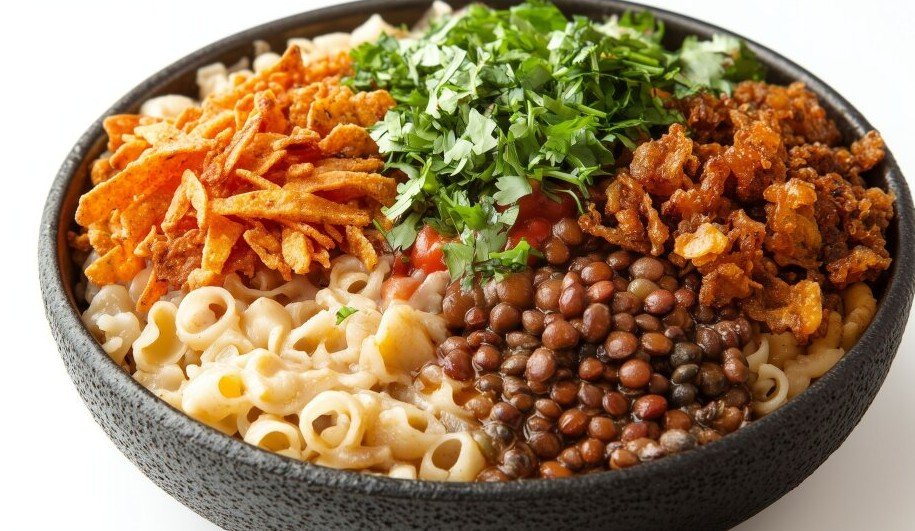
As Ehab Medhat, a consultant with the Arab Foundation for Development and Strategic Studies, put it, koshary is “an essential part of the country’s social fabric and culinary heritage.”
That language may sound formal, but the idea is simple.
People eat koshary when they’re broke. When they’re celebrating. When they’re tired. When they’re hungry at midnight.
It belongs to everyone.
And that universality is exactly what caught UNESCO’s attention.
Born from empire, shaped by the street
Koshary’s origin story isn’t romantic. It’s practical.
The dish took shape in the 19th century, during British rule, at a time when Egypt’s cities were swelling with workers, migrants, and traders. Ingredients from different corners of the empire collided in local markets.
Rice from Asia. Lentils from the Middle East. Pasta, likely inspired by Italian communities in Egypt. Tomato sauce layered in later.
Individually, these weren’t Egyptian staples.
Together, they became one.
Medhat explains that the dish spread because it solved a basic problem. It was cheap. Filling. Easy to scale for urban life.
One short sentence here.
Koshary fed cities.
A blend that became Egyptian through repetition
Some foods chase purity. Koshary never did.
It absorbed influences and didn’t apologize for it. Over time, Egypt made it its own through habit rather than ceremony.
That’s why calling it “inauthentic” misses the point.
Its authenticity comes from being cooked the same way, again and again, by different hands, in different neighborhoods, with slight variations that nobody argues too much about.
It’s assembled, not stirred. Each layer has a job. The rice grounds it. The lentils add weight. The pasta stretches it. The sauce binds it. The onions finish it.
People joke that it’s complicated because it uses multiple pots.
In reality, it’s efficient.
How koshary works in real life, not cookbooks
Walk into a typical koshary shop in Cairo and you’ll see speed, not ceremony. Orders fly. Hands move fast. Portions are generous.
The structure is consistent, even if the ratios vary.
-
Rice and lentils form the base
-
Pasta adds bulk and texture
-
Tomato sauce brings acidity
-
Fried onions deliver crunch
-
Vinegar and chili are optional but loved
One sentence pause again.
Nobody asks for a menu explanation.
That predictability is comfort. You know what you’re getting, even before the bowl hits the counter.
Street food that crossed every social line
What makes koshary unusual is how evenly it cuts across class.
Office workers eat it standing up. Students eat it sitting on sidewalks. Families take it home in plastic bags knotted tight.
You’ll find it downtown, in wealthy suburbs, near bus stations, and next to mosques.
Few foods manage that kind of reach.
That’s why UNESCO’s recognition felt less like an award and more like a mirror held up to Egyptian life.
Here’s a simple comparison that puts things in perspective:
| Aspect | Koshary | Fine-Dining Egyptian Dishes |
|---|---|---|
| Cost | Very low | High |
| Availability | Everywhere | Limited |
| Preparation | Layered, fast | Time-intensive |
| Audience | Everyone | Select |
The table isn’t about ranking quality.
It’s about reach.
More than food, a shared habit
Koshary doesn’t need a special occasion. That’s part of its strength.
People disagree on politics. On football teams. On everything, really. But koshary sits outside those arguments.
It’s what you eat when there’s no time to think.
That daily intimacy matters. UNESCO didn’t just recognize a dish. It recognized the act of eating it, serving it, and passing it down without formal instruction.
Mothers teach it. Shops refine it. Streets sustain it.
And all of that happens quietly.
Global recognition, local pride
International recognition often comes with mixed feelings. Some worry about commercialization. Others fear dilution.
With koshary, the reaction inside Egypt leaned heavily toward pride.
Because the dish didn’t change to be recognized.
It stayed exactly where it was. In metal bowls. On plastic tables. In hands that have served it for decades.
One sentence, because it sums things up.
UNESCO caught up to what Egyptians already knew.
A future written in repetition
Koshary’s listing doesn’t freeze it in time. It doesn’t lock the recipe. It doesn’t turn it into a performance.
It acknowledges something living.
As long as people keep lining up, keep layering, keep eating, the tradition holds.
And in a world obsessed with trends, there’s something grounding about that.
A dish that never tried to be special, now officially recognized for being exactly what it is.