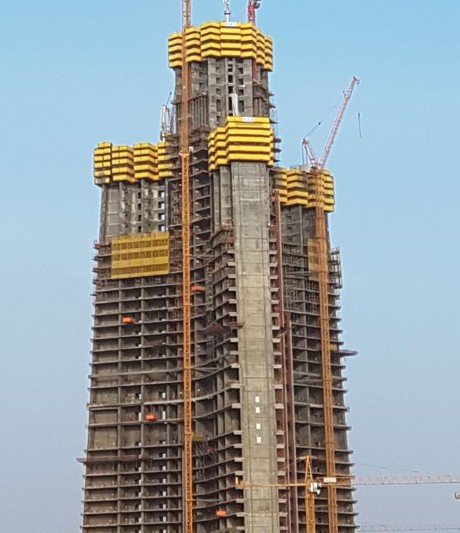
The race for the world’s tallest structure is heating up again. Saudi Arabia’s long-paused Jeddah Tower has crossed the 80-floor mark, reviving a project once written off as too ambitious, too political, or simply cursed by time.
Momentum is back, and it’s hard to ignore.
A stalled dream comes roaring back to life
For years, Jeddah Tower felt like a half-finished promise baking under the Red Sea sun. Construction stopped. Cranes froze. Rumors flew. Some said it would never restart.
Then January 2025 happened.
Work resumed quietly at first, then loudly. By mid-2025, the tower was climbing at a pace few supertalls ever manage. Contractors began adding a new floor roughly every three to four days. Basically, blink and it’s taller.
By August, the structure had reached about 75 floors. As of December, it has moved beyond 80, according to project updates and reporting cited by Newsweek. That puts the building well past the psychological halfway point, both in height and belief.
One sentence matters here. The goal is no longer theoretical.
Engineering at the edge of what concrete can do
This tower isn’t just tall. It’s pushing materials and logistics into uncomfortable territory.
Saudi Binladin Group is leading construction, with Dar Al-Handasah overseeing design and engineering, while Turner Construction supports project management. Together, they’re pulling off a concrete pour that borders on absurd by normal standards.
High-pressure pumping systems push concrete hundreds of meters upward, fighting gravity every second. Engineers often joke that concrete doesn’t like heights. This project disagrees.
The core structure alone requires extreme precision.
-
More than 150 total floors are planned
-
Over half of the concrete core is already poured
-
Multiple tower cranes operate simultaneously to keep pace
One small paragraph matters here.
Every extra meter makes wind behavior stranger and structural tolerances tighter.
Unlike Burj Khalifa, which steps back in a tiered form, Jeddah Tower rises as a slender, tapering needle. That design reduces wind vortex effects but raises the stakes for balance and damping systems.
Basically, there’s no room for “close enough.”
How Jeddah Tower compares to Burj Khalifa right now
Dubai’s Burj Khalifa still holds the crown at 828 meters. That number has been untouched since 2010. For 15 years, no project seriously threatened it.
Jeddah Tower aims for about 1,000 meters.
That gap matters. It’s not symbolic. It’s structural, financial, political. And yes, bragging rights play a role.
Here’s a simple comparison based on publicly available figures:
| Feature | Burj Khalifa | Jeddah Tower (planned) |
|---|---|---|
| Height | 828 meters | ~1,000 meters |
| Floors | 163 | ~157 |
| Completion | 2010 | Target 2028 |
| Primary use | Mixed-use | Mixed-use |
| Developer | Emaar | Jeddah Economic Co. |
One short sentence stands alone.
Height is not everything, but it’s the headline.
Burj Khalifa remains operational, profitable, and iconic. Jeddah Tower, meanwhile, is still a promise under construction, one that carries far more risk simply because it aims higher.
Vision 2030 and why this tower matters now
Timing explains a lot.
Saudi Arabia’s Vision 2030 push has shifted from planning documents to visible, concrete-heavy reality. Mega-projects like NEOM, Qiddiya, and the Red Sea resorts are already reshaping investment flows.
Jeddah Tower fits this moment better than it did a decade ago.
Back then, the project struggled with funding disputes, corruption investigations tied to the 2017 anti-graft purge, and pandemic-era shutdowns. Confidence evaporated.
Now, confidence is being poured in cubic meters.
One paragraph, one thought.
This tower is less about height and more about signaling.
Saudi officials see it as proof that stalled ambitions can restart, that capital still shows up, and that engineering limits are negotiable. Critics call it extravagance. Supporters call it momentum.
Both are probably right.
The risks that still hang in the air
Despite the visible progress, nobody involved is declaring victory early. Towers don’t care about optimism.
Several challenges remain unresolved.
Financing must stay steady through 2028. Global interest rates have softened but remain unpredictable. Material costs swing. Skilled labor at this altitude is scarce and expensive.
Then there’s weather.
Wind loads increase dramatically past 700 meters. Heat affects curing times. Sandstorms interrupt schedules without apology.
There’s also the question of demand. Once complete, Jeddah Tower is expected to house luxury residences, offices, a hotel, and observation decks. The business case depends on sustained interest from global tenants and tourists.
Saudi Arabia is betting that interest will come.
A skyline statement that goes beyond architecture
Jeddah Tower is already reshaping the city’s skyline, even unfinished. From certain angles along the Red Sea coast, it looks unreal, like a pencil drawn too far upward.
Locals have mixed feelings.
Some see pride. Others see money tied up in concrete when housing and infrastructure still need work. Taxi drivers talk about it casually, like it’s always been there, which is kind of wild.
What’s clear is that this project has reentered the global conversation. Architecture forums, construction analysts, and financial desks are watching again. The question has shifted from “Will it ever resume?” to “Can it actually finish?”
If current pace holds, topping Burj Khalifa is no longer a joke headline. It’s a scheduling problem.
And those tend to get solved, one floor at a time.