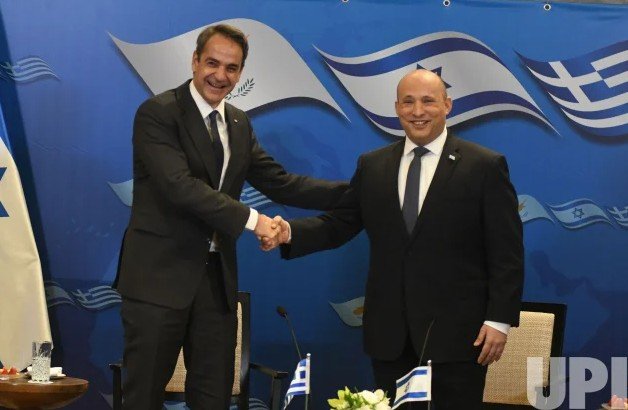
Leaders from Cyprus, Greece and Israel gathered in Jerusalem this week with a clear message: their trilateral partnership is no longer a side project. It is becoming a core pillar of regional coordination, shaped by security fears, energy ambitions and a shared sense that instability nearby leaves little room for hesitation.
The 10th Trilateral Summit ended with a sweeping Joint Declaration, laying out how far the cooperation has come and where it is heading next.
A Trilateral Format Moving From Dialogue to Structure
The Jerusalem summit marked more than another round of familiar diplomatic language.
Cyprus, Greece and Israel agreed to further institutionalize their cooperation, committing to annual leaders’ summits and tighter coordination at ministerial and technical levels. The aim, according to officials, is to make the framework predictable, durable and less dependent on personalities.
In the Joint Declaration, the three leaders spoke of an “unwavering commitment” to the trilateral format. That wording was deliberate. It signals that the partnership is meant to outlast political cycles and short-term crises.
They also reaffirmed the so-called 3+1 format with the United States, while leaving the door open to other like-minded partners. The message was subtle but firm. This is an open architecture, but not an unfocused one.
One sentence in the declaration stood out. Stability, they argued, is built, not improvised.
Cyprus–Israel Ties Highlighted in Bilateral Talks
Earlier in the day, Israeli President Isaac Herzog hosted Cypriot President Nikos Christodoulides for bilateral discussions that set the tone for the wider summit.
Herzog described Cyprus–Israel relations as having reached “enormous” levels in recent years. He praised Cyprus as a stabilizing force in the Eastern Mediterranean, calling it a bridge for peace and a contributor to regional functionality.
He also pointed to people-to-people ties, noting that Israelis feel a strong affinity for Cyprus. That bond, he suggested, gives political cooperation a deeper foundation.
Christodoulides echoed the sentiment, saying his visit blended bilateral diplomacy with trilateral engagement. The overlap, he argued, is where momentum is built.
Tangible Cooperation Beyond Statements
Christodoulides stressed that the partnership is no longer abstract.
He cited concrete cooperation in defense, energy, innovation, trade and tourism. One striking example was travel. During peak summer months, flights between Cyprus and Israel have reached as many as 186 per week, a figure officials use as shorthand for how interconnected the societies have become.
That level of movement, he said, creates trust that no joint declaration alone can manufacture.
There was also a clear attempt to show continuity. Several initiatives discussed in previous summits are now moving into implementation phases, rather than being recycled as future goals.
This shift from promise to practice was a recurring theme throughout the day.
Drawing the European Union Closer In
A central priority for Cyprus, in particular, is bringing the European Union more directly into the trilateral framework.
Christodoulides said this would be a focus during Cyprus’s upcoming Presidency of the Council of the EU. The goal is to align trilateral projects with EU policies, funding instruments and regulatory structures.
That matters for two reasons.
First, it gives initiatives political weight beyond the region. Second, it offers access to resources that small and medium-sized states cannot easily mobilize on their own.
Linking Eastern Mediterranean cooperation with Brussels, officials believe, also helps shield projects from regional shocks.
It’s a strategic hedge, basically.
Security and Defense at the Core
Security discussions took up a significant portion of the summit.
The leaders agreed to strengthen coordination on counter-terrorism, maritime security and military cooperation. Protection of critical maritime infrastructure was highlighted as a shared concern, especially as undersea cables, pipelines and ports become more exposed.
Particular attention was given to Cyprus’s planned Maritime Cybersecurity Center of Excellence, expected to become operational in 2026. The center is intended to serve as a regional hub, focusing on cyber threats targeting maritime assets.
This wasn’t framed as a military alliance.
Instead, officials described it as preventive cooperation, aimed at reducing vulnerabilities before crises erupt.
Gaza, Humanitarian Action and Regional Tensions
Regional developments, especially Gaza, were discussed at length.
The leaders acknowledged humanitarian contributions made by Cyprus and Greece, notably through the “Amalthea” maritime corridor, which has been used to facilitate aid deliveries. They stressed the importance of ensuring humanitarian access while maintaining security considerations.
The Joint Declaration called for the immediate return of remaining Israeli hostages and the disarmament of Hamas under agreed frameworks. At the same time, it reaffirmed Israel’s right to self-defense in accordance with international law.
That balance was carefully worded.
It reflects the tightrope the trilateral partnership is trying to walk, combining security alignment with humanitarian messaging.
Energy and Connectivity Take Strategic Priority
Energy and connectivity emerged as central pillars of the partnership.
Cyprus, Greece and Israel reiterated their commitment to joint projects in natural gas development, electricity interconnections and renewable energy. These efforts are grounded, they emphasized, in respect for international law and Exclusive Economic Zones.
The Great Sea Interconnector featured prominently in discussions. Leaders described advancing the project, and linking it to the India–Middle East–Europe Economic Corridor, as strategically vital.
Energy officials see this not just as infrastructure, but as insurance.
Diversified routes, multiple partners and shared ownership are meant to reduce exposure to political pressure and supply shocks.
Cooperation That Reaches Beyond Hard Power
The declaration went further than security and energy.
New areas of cooperation include emergency preparedness, environmental protection, climate action, health, science, technology and artificial intelligence. Several new trilateral working groups are set to be established.
There was also a push to strengthen access to EU research programs, including Horizon, which officials see as a way to anchor innovation collaboration within a broader European framework.
This softer side of cooperation received less attention publicly, but diplomats privately describe it as essential for long-term resilience.
Hard security may grab headlines. Civil resilience sustains partnerships.
Shared Democratic Framing and Wider Regional Signals
The leaders emphasized the democratic foundations of their partnership, framing the trilateral format as a constructive platform rather than an exclusionary bloc.
They rejected what they described as destabilizing ambitions in the region and presented their cooperation as compatible with a broader regional security architecture.
On wider regional issues, the declaration welcomed progress in dialogue between Israel and Lebanon and reaffirmed support for Lebanon’s sovereignty. The leaders also reiterated their commitment to expanding the Abraham Accords.
Jerusalem’s importance to the three monotheistic religions was reaffirmed, alongside a pledge to uphold the status quo at holy sites and protect Christian heritage.
Condemnations and Diplomatic Closure
The Joint Declaration strongly condemned antisemitism worldwide and reaffirmed support for a just, comprehensive and sustainable solution to the Cyprus problem, based on international law and relevant UN Security Council resolutions.
The day ended on a diplomatic note.
Christodoulides invited Herzog to visit Cyprus, an invitation that was accepted. He also held a separate phone call with Mahmoud Abbas, underscoring Cyprus’s effort to keep channels open across the region.
The Jerusalem summit made one thing clear. The Cyprus–Greece–Israel partnership is no longer content with symbolism. It is positioning itself as a steady, if cautious, anchor in a region where anchors are in short supply.