
Greece is wrestling with a demographic crisis that’s casting a long shadow over policy debates, pushing migration back to the center of national conversation. At the heart of it lies an old bond with Middle Eastern Christian communities — a connection carrying history, emotion, and complicated questions about identity.
A Debate Stuck Between Extremes
The national argument over migration often gets stuck between two loud camps.
One pushes for zero tolerance, imagining that simply sealing borders will fix deeper social problems.
The other says Greece should keep expanding legal migration channels, treating economic gain as the guiding principle.
One sentence here for rhythm.
Neither side fully captures the reality unfolding in homes, workplaces, and parishes across the country.
Fertility rates are anchored at levels too low to sustain the population.
Family structures have loosened as individualism rises.
And even generous financial incentives haven’t convinced young couples to have more children.
That’s not a Greek phenomenon alone — it’s similar across Europe — but for Greece, the stakes feel heavier because the population decline has been sharper and longer-lasting.
The Coming Demographic Cliff
Everyone agrees on one point: Greece is heading into dangerous demographic territory.
The numbers aren’t vague predictions anymore.
Social security sustainability is already being challenged by an aging population and a shrinking workforce.
Economists warn that the ratio of workers to retirees could hit alarming lows over the next two decades.
A single sentence pause keeps the flow natural.
These issues aren’t abstract; they affect pensions, healthcare systems, and long-term fiscal stability.
The conversation is no longer about the distant future — it’s about the next chapter Greece will face whether it’s ready or not.
Learning From Europe’s Past Mistakes
Policy experts keep pointing to Western European nations and saying, “don’t copy that model.”
They’re referring to large inflows that weren’t integrated properly.
Unmanaged mass migration — especially where cultural distance is wide — can create parallel societies.
These rarely dissolve over time.
As many Greek analysts like to say, national identity depends on unifying elements: language, shared customs, religious memory.
These evolve, yes, but they don’t disappear without leaving a void.
Here’s where one quick bullet sits naturally:
– Policymakers argue that any migration framework must avoid feeding social fragmentation that becomes impossible to reverse later.
It’s a blunt point, but one that’s shaping the current debate.
A Historic Bond Renewed: Middle Eastern Christians
Greece’s relationship with Middle Eastern Christians stretches back centuries.
It’s not diplomatic or transactional — it’s historical, almost familial.
Around 1 million Arabic-speaking Orthodox Christians still live in Lebanon, Syria, Jordan, and the Palestinian territories.
They call themselves Romioi, echoing the name Byzantines once used for themselves.
One sentence to give the section breathing space.
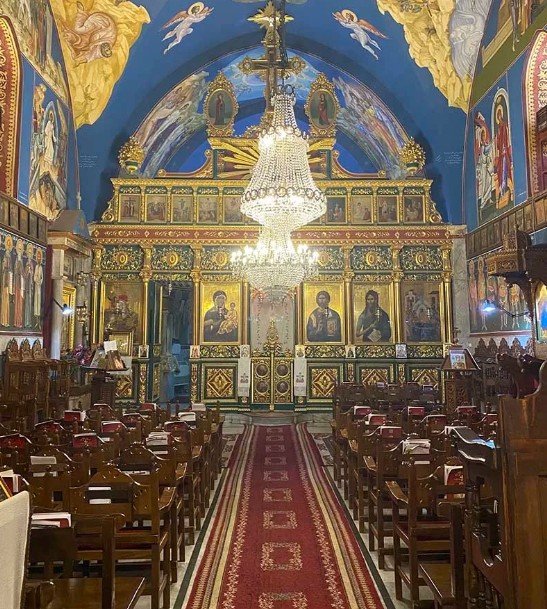
These communities form the last surviving thread of the Byzantine world in the East.
During the Ottoman years, Greeks and these Romioi lived under the broader banner of the same religious-cultural identity, the genos.
They weren’t a nation in the modern Western sense.
They were a community defined by liturgy, heritage, and shared memory.
Philosopher Christos Yannaras often wrote that the Western notion of nationhood reshaped Greek thought.
It pushed Greeks to redefine their identity beyond the older Byzantine perspective.
What Migration Could Mean for Both Sides
This is where the old bond becomes politically relevant again.
Some in Athens believe Greece could offer a natural refuge for these communities, especially as instability continues across parts of the Middle East.
For many policymakers, the cultural familiarity matters.
Greek Orthodoxy is woven into both histories.
One small paragraph adds a human pause.
Others warn that even groups with close cultural ties face integration challenges when transitions happen at scale.
To help clarify, here’s a simple reference table comparing key identity elements:
| Identity Aspect | Greek Population | Middle Eastern Orthodox Christians |
|---|---|---|
| Religious Tradition | Eastern Orthodox | Eastern Orthodox |
| Historical Label | Hellene / Romios | Romioi |
| Cultural Link | Byzantine heritage | Byzantine heritage |
| Primary Language | Greek | Arabic |
That table reflects a closeness rare in migration debates.
Still, policymakers know cultural affinity alone doesn’t guarantee seamless integration.
Economic factors matter.
Urban capacity matters.
Public support matters.
Three short sentences close this section smoothly.
Balancing Heritage With Modern Realities
Some analysts argue that Greece has a unique opportunity.
It can design a migration model shaped by history, not by imported ideologies.
And by acknowledging shared heritage with certain communities, Greece may avoid the pitfalls faced elsewhere.
One sentence here to keep momentum: the conversation is becoming more urgent with each new report on population decline.
Whether Greece chooses a cautious opening, a selective policy, or a hybrid plan remains to be seen.
But the debate has unquestionably moved from the margins to the mainstream.
And it’s doing so at a time when the country must decide how it defines itself — and who it welcomes into that future.
