
Israel is many things at once. A modern state. An ancient homeland. A symbol carried in prayer, memory, and argument. The tension around who “belongs” there did not begin in 1948, or 1917, or even 70 CE. It goes deeper, into faith itself, and into how history is remembered, claimed, and sometimes rewritten.
Much of the current debate feels loud but shallow. It skips over uncomfortable facts. It blurs theology with nationhood. And it often treats Jewish connection to the land as optional, conditional, or negotiable. That framing didn’t come from nowhere. It was built, layer by layer, across centuries.
One land, three faiths, very different relationships
The land commonly called Israel or the Holy Land holds sacred meaning for Jews, Christians, and Muslims. That much is true. But shared reverence does not equal shared historical claims.
For Jews, the land is central, concrete, and continuous. It is named, mapped, prayed for, and legislated in Jewish texts for more than three thousand years. Jewish law, language, holidays, and identity are inseparable from specific places in that land.
Christianity and Islam relate to the land differently.
Christian theology is not land-based in the same way. Its sacred geography is symbolic more than national. Islam’s connection, while deeply religious, emerged centuries later and was shaped by imperial expansion rather than indigenous nationhood.
These differences matter. Ignoring them creates confusion that often turns into accusation.
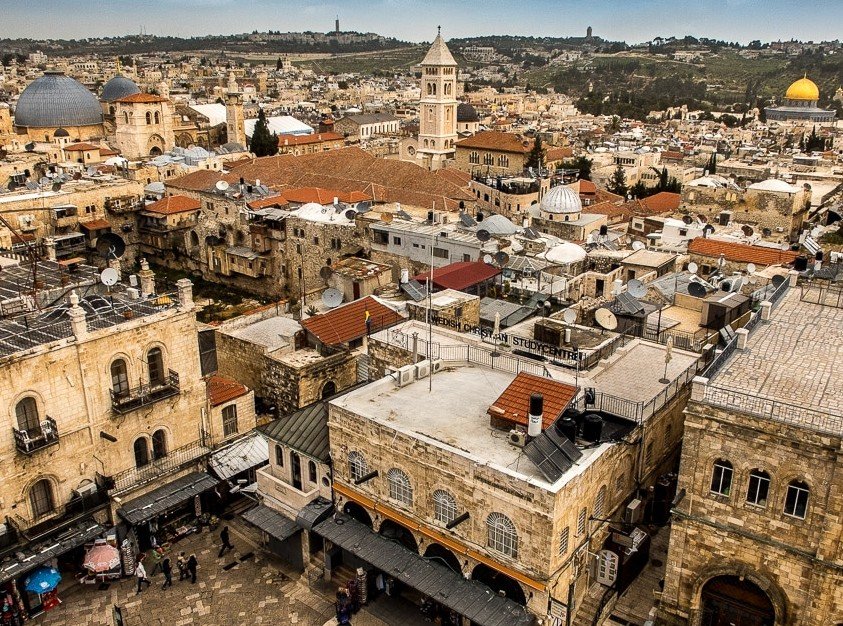
Christianity’s roots and its break from land-based identity
Christianity emerged from Judaism. That point is not controversial, though it is sometimes conveniently downplayed.
Jesus was Jewish. His followers were Jewish. The texts that form the Christian Bible are saturated with Jewish law, prophecy, and history. Early Christianity existed entirely within Jewish society in Roman Judea.
But Christianity did not remain a land-rooted people.
After the Roman destruction of Jerusalem in 70 CE, Christianity spread outward. Fast. Its center shifted to Rome, Constantinople, and later Europe. It became a faith defined by belief, not territory. By the fourth century, it was the religion of empire.
Christians did not maintain a continuous national presence in the land as a people with their own language, courts, or sovereignty. Pilgrimage replaced indigeneity. Memory replaced nationhood.
That is not a criticism. It is simply history.
Yet modern arguments sometimes frame Christians as equally indigenous to the land, as if theological reverence alone creates national belonging. That leap does not hold up under scrutiny.
Jewish continuity rarely fits the slogans
A persistent myth suggests Jews “left” and then “returned” centuries later. Reality is messier and far less convenient.
Jewish presence in the land never ended.
Through Roman, Byzantine, Islamic, Crusader, Ottoman, and British rule, Jews remained. Sometimes in large numbers, sometimes barely tolerated, sometimes massacred. But never gone.
Hebrew never disappeared. Jewish prayer never removed Jerusalem from its center. Every Passover, every wedding, every funeral reinforced the same direction. Toward Zion.
Even in exile, Jewish identity stayed tied to land, law, and peoplehood. That combination is what defines indigeneity.
Indigenous status does not require uninterrupted sovereignty. Very few indigenous peoples on earth meet that standard. It requires continuous identity, memory, and connection. Jews meet all three.
Islam’s later arrival and political dominance
Islam entered the land in the seventh century, during the Arab conquests. It brought genuine religious attachment, especially to Jerusalem, which became the third-holiest site in Islam.
But religious importance is not the same as indigenous origin.
Islamic rule over the land came through empire. The language, administration, and ruling elite were imported. Over time, local populations converted, intermarried, and adapted. That process created deep roots for Muslim communities, but it did not erase earlier Jewish identity.
Here’s where debates often derail.
Acknowledging Jewish indigeneity does not deny Muslim presence or rights. It challenges the idea that Jewish sovereignty is an intrusion rather than a restoration.
Those are very different frames.
Replacement theology and the long shadow it casts
Christian replacement theology, the belief that the Church replaced Israel in God’s covenant, shaped centuries of attitudes toward Jews. It also shaped how land was viewed.
If Jews were no longer the chosen people, then their connection to the land could be spiritualized away. Promises became metaphors. Geography became optional.
That theology did not stay abstract. It justified exile, marginalization, and later, resistance to Jewish return.
Even today, some secular arguments echo that logic without using religious language. Jews are cast as guests, colonizers, or temporary residents in their own ancestral home.
The language has changed. The assumption has not.
Modern Israel and the collision of narratives
The establishment of Israel did not create Jewish connection to the land. It formalized it politically.
Modern Israel emerged in a world shaped by nationalism, borders, and international law. Its birth collided with Arab nationalism and with communities that had lived there for generations under previous empires.
That collision produced real suffering. It also produced a state rooted in ancient identity.
Two things can be true at once.
Ignoring Jewish indigeneity makes peace harder, not easier. It frames Jewish existence as provisional. It turns compromise into surrender and coexistence into erasure.
History shows how that ends.
Who belongs is not a zero-sum question
Belonging is not ownership in the abstract. It is layered.
Jews belong to the land as an indigenous people. Muslims and Christians belong as communities with centuries of continuous presence. Those facts are not mutually exclusive.
The problem begins when one group’s belonging is denied to elevate another’s.
That denial fuels absolutism. It replaces history with slogans. It turns a complex land into a moral courtroom.
Real coexistence starts with honesty. Not balance for its own sake. Not symmetry where none exists. But clarity.
Israel is not a random colonial project. It is not a theological accident. It is the political expression of a people who never stopped being tied to a specific land.
