
Egypt has taken a decisive lead in Africa’s renewable energy race, signing deals worth $1.8 billion as it accelerates toward an ambitious clean power target, a scale of investment that now clearly outpaces Nigeria’s more modest $500 million solar drive.
The contrast highlights how differently the continent’s two largest economies are approaching the energy transition, and what that may mean for growth, power security, and competitiveness over the next decade.
Cairo doubles down on clean power ambition
Egypt’s latest agreements, announced by state television on Sunday, are aimed squarely at meeting a national target to source 42 per cent of its electricity generation from renewables by 2030.
That figure matters. It signals a shift from pilot projects to industrial-scale deployment, at a time when energy demand continues to climb across North Africa.
Officials say the combined $1.8 billion package covers multiple projects, with a strong focus on solar generation. Among the most prominent partners is Scatec, which has become a familiar name in Egypt’s renewable expansion over recent years.
The first project under the new deals will involve the construction of a large solar power plant, adding further capacity to a grid that is already one of the strongest on the continent.
For Cairo, this is about momentum.
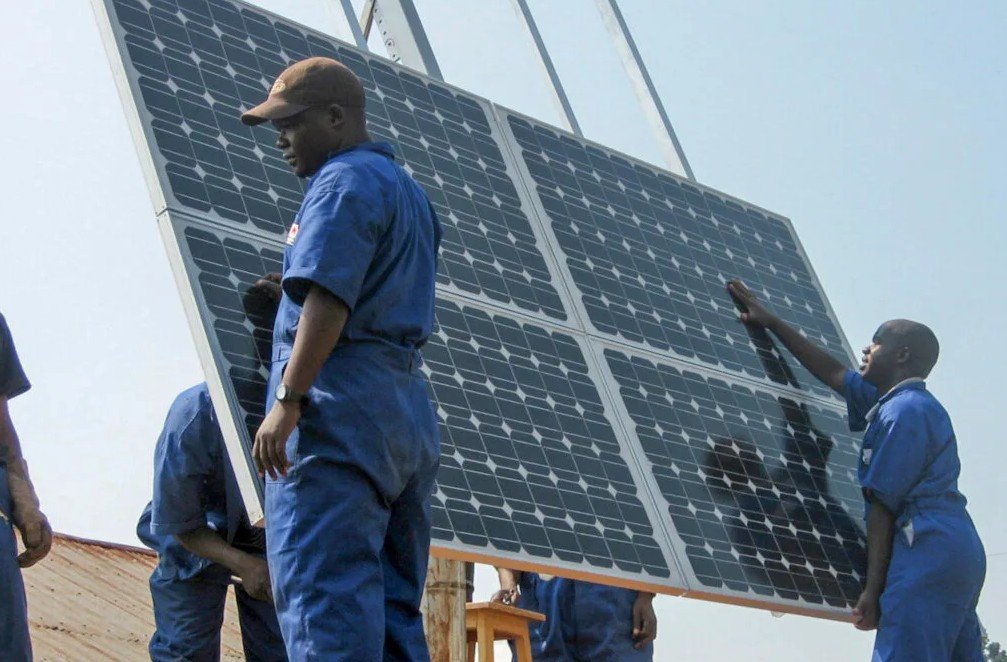
Nigeria’s solar ambitions look smaller by comparison
Nigeria, Africa’s most populous country, has also been talking up renewable energy.
Recently, Abuja announced agreements worth about $500 million, involving five state governments and the Netherlands Development Organisation. The goal is to boost solar generation, encourage local manufacturing of panels, and expand battery storage capacity.
On paper, the plans are meaningful. In reality, the scale is limited when set beside Egypt’s push.
The gap is not just financial. It is structural.
Nigeria’s renewable plans remain fragmented across states and pilot programmes, while Egypt is executing centrally coordinated, grid-connected projects measured in billions.
That difference shapes outcomes.
Power generation numbers tell a stark story
The contrast becomes sharper when current electricity output is considered.
As of 2024, Egypt was generating more than 35,000 megawatts of power for a population of roughly 119 million people. Nigeria, by comparison, was producing about 5,300 megawatts for more than 200 million citizens.
Those figures are widely cited by energy analysts and reflect years of diverging policy execution.
In practical terms, Egypt has surplus capacity at times. Nigeria struggles to keep the lights on.
Renewables are not the only reason for that gap, but they are becoming an increasingly important part of the explanation.
Why Egypt keeps attracting large-scale investment
Egypt’s appeal to international developers rests on several pillars.
First, there is grid readiness. Transmission infrastructure has expanded significantly over the past decade, allowing new power to be absorbed without major bottlenecks.
Second, there is policy clarity. Renewable targets are clear, procurement frameworks are established, and state-backed offtake agreements reduce risk for investors.
Third, there is geography. Egypt enjoys some of the highest solar irradiation levels in the region, particularly in desert areas well suited to utility-scale plants.
Companies like Scatec have benefited from this combination, scaling up projects with relative speed compared to many other African markets.
For investors, predictability matters almost as much as sunlight.
Nigeria’s challenges go beyond funding
Nigeria’s renewable ambitions face hurdles that money alone cannot fix.
Grid limitations remain severe. Even when generation exists, transmitting power reliably across the country is a challenge. Distribution losses, technical faults, and non-payment issues weigh heavily on the sector.
There is also policy inconsistency. While federal plans often sound ambitious, implementation depends on state-level coordination, regulatory approvals, and financing structures that can shift with political cycles.
Solar projects, especially off-grid systems, have found some success in rural areas. Scaling that success to industrial or national impact has proved harder.
That reality explains why Nigeria’s $500 million push, while important, does not yet signal a decisive turning point.
Egypt’s target comes with its own risks
Despite the headline numbers, Egypt’s renewable ambitions are not without pressure points.
Officials privately acknowledge that meeting the 42 per cent target by 2030 will require sustained international support, including concessional finance, technology transfer, and grid upgrades.
Large solar plants demand upfront capital. Currency volatility, global interest rates, and geopolitical risk can complicate financing even in relatively stable markets.
There is also the challenge of balancing renewables with conventional power sources to maintain grid stability, especially during peak demand.
In short, the path is promising, but not guaranteed.
What this means for Africa’s energy transition
The Egypt–Nigeria comparison offers a wider lesson.
Africa’s energy transition is not moving at a uniform pace. Some countries are racing ahead with billion-dollar projects and clear timelines. Others are advancing incrementally, constrained by infrastructure and institutional limits.
This divergence could have long-term consequences.
Countries that secure reliable, affordable power earlier may gain advantages in manufacturing, data centres, and green industries. Those that lag risk deeper dependence on diesel, generators, and costly imports.
Renewable energy, in this context, is not just about climate goals. It is about economic positioning.
Solar power as a signal, not just a solution
For Egypt, the $1.8 billion announcement is also a signal to markets.
It tells investors that the country is open for large-scale clean energy deals, that projects can reach financial close, and that the state is willing to commit to long-term power planning.
For Nigeria, the signal is more cautious. Interest exists, but the ecosystem is still forming.
That difference shapes perception, which in turn shapes capital flows.
A widening gap, for now
At present, Egypt’s renewable drive clearly dwarfs Nigeria’s solar ambitions, both in dollar terms and in execution capacity.
Whether Nigeria can close that gap will depend on reforms that go beyond individual deals, touching grids, regulation, and investor confidence.
