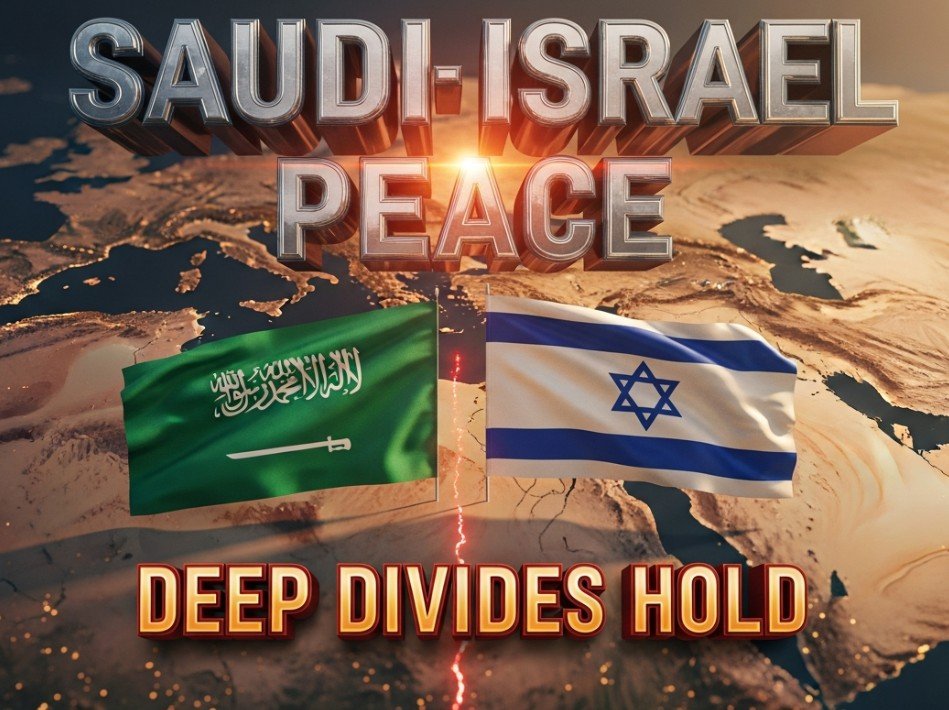
Saudi Arabia’s much-anticipated peace with Israel remains stalled as deep political, social and religious divides shape Riyadh’s approach toward Jewish sovereignty and normalization in the Middle East. Recent developments show that despite private diplomatic contact and U.S. pressure, official ties between the two nations are still distant, and critics argue that Saudi leaders must address both domestic sentiment and longstanding regional concerns before any formal peace deal can happen.
Public social media trends and official rhetoric reveal a disconnect, suggesting peace prospects may hinge on far more than simple diplomacy. Saudi-linked online campaigns in January branded neighboring Gulf states aligned with Israel in deeply negative terms, reigniting debates about the future of regional cooperation and the status of Jewish sovereignty in Arab politics.
Saudi Online Rhetoric and Public Sentiment
Across Arabic-language social media platforms in late January, a coordinated spike in anti-UAE and anti-Israel hashtags quickly spread through various networks. Terms labeling the United Arab Emirates as a “Zionist proxy” and a “Trojan Horse” surfaced with remarkable uniformity, attacking Gulf neighbors for their ties with Israel and framing those ties as an affront to Islam and regional values. These trends peaked around sensitive regional anniversaries, amplifying emotional response rather than reasoned policy debate.
This surge underscores a broader issue within Saudi public discourse: many Saudis view normalization with Israel as incompatible with their cultural and religious ethos unless Palestinian aspirations are fully addressed first. Although public opinion inside Saudi Arabia is hard to measure due to strict limits on speech and media, available research suggests that sentiment remains strongly influenced by pro-Palestinian narratives.
Riyadh’s Strategic Calculus and Policy Conditions
Saudi leadership has not rejected dialogue with Israel outright. Behind closed doors, senior Saudi officials have engaged with U.S. representatives and allied politicians on regional security, defense cooperation and the potential for normalization under the broader Abraham Accords framework.
However, current policy positions emphasize specific prerequisites before any official peace deal is signed. Riyadh has consistently linked normalization to progress toward Palestinian statehood — a demand that Israel’s current government has publicly rejected in key statements. Prime Minister Benjamin Netanyahu recently reiterated that the establishment of a Palestinian state would not be considered as part of normalization talks.
This condition builds on Riyadh’s long-standing diplomatic posture outlined decades ago in the Arab Peace Initiative, which offered full recognition of Israel only if Israel withdrew from territories occupied since the 1967 war and advanced a just peace for Palestinians.
Shifts and Tensions Within Saudi Policy
Recent private commentary and Saudi media analysis show internal balancing acts among Saudi policymakers. Crown Prince Mohammed bin Salman appears to weigh the strategic benefits of diplomatic engagement against powerful domestic resistance to recognizing Israel without Palestinian progress. As a result, Riyadh has taken a cautious stance, emphasizing economic and defense cooperation with the United States while deferring any public normalization breakthrough.
This cautious posture has been reinforced by broader regional dynamics. While earlier U.S. efforts sought to include Saudi Arabia in the Abraham Accords after the initial agreements with the UAE and Bahrain, momentum slowed amid the ongoing fallout from the Israeli-Palestinian conflict and shifting political priorities in Washington.
Indeed, analysts note that domestic risks are now a central factor in Riyadh’s calculations, with concerns that rushed normalization could erode public support and destabilize internal cohesion. For now, Saudi authorities appear to prefer economic incentives and defense partnerships over contentious diplomatic symbolism, a shift that some experts describe as a de-escalation of normalization urgency.
Regional Rivalries and Diplomatic Ripples
Saudi Arabia’s position also reflects broader geopolitical rivalries. The kingdom’s relationship with the United Arab Emirates — one of Israel’s closest Gulf partners — has experienced strains, partially due to differing approaches to Israel and competition for regional influence. This divergence has contributed to a more complex diplomatic environment, with Riyadh pursuing ties with countries like Turkey and Qatar, where political alignment toward Israeli policy differs from Gulf consensus.
Furthermore, Saudi-linked media outlets have adopted increasingly sharp anti-Israel rhetoric, intensifying concerns in U.S. and Israeli policy circles about a potential rollback of engagement efforts. This shift raises questions about the extent to which public and state media influence could shape long-term diplomatic trends.
What Comes Next for Peace Prospects
The key barriers to a Saudi-Israel peace agreement extend beyond bilateral diplomacy. They include:
• Public and media sentiment that remains strongly opposed to unconditional recognition of Israel without Palestinian rights advanced.
• Israeli political rejection of core Saudi conditions, especially full Palestinian sovereignty.
• Domestic and regional geopolitical factors that reshape priorities for Riyadh and its partners.
Experts emphasize that any meaningful shift toward peace will require sustained efforts to address the Palestinian question squarely and transparently, bridging the gap between public expectations and diplomatic realities.
As long as these core issues remain unresolved, peace between Saudi Arabia and Israel will likely stay aspirational rather than imminent — deeply entwined with the broader hope for a just and lasting resolution to one of the Middle East’s most enduring conflicts.
Saudi Arabia’s cautious approach shows that true peace will require not just political strategy but genuine reconciliation of competing narratives and aspirations across the region.