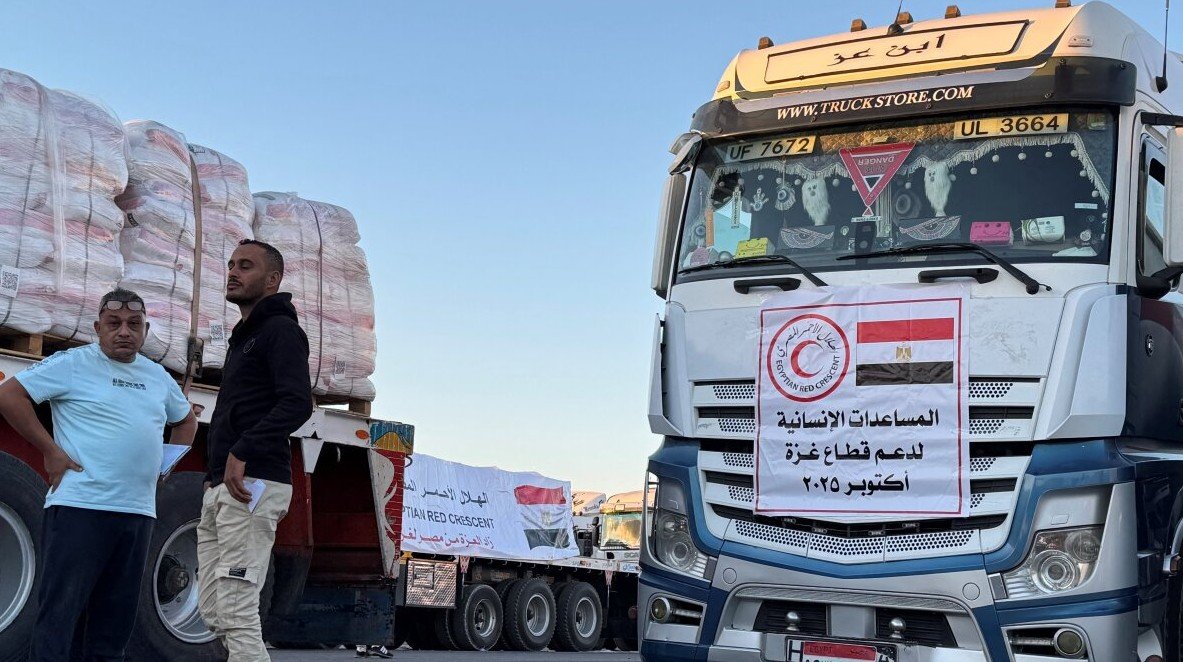
In the early hours of Monday, Egypt moved thousands of tons of humanitarian assistance toward Gaza, underscoring Cairo’s steady role as a lifeline as conditions worsen inside the enclave. The convoy crossed from Egypt’s side of the border and headed onward after inspection, carrying food, medicine, fuel, and shelter items in bulk.
The shipment totaled about 7,200 tons. It was large. Really large. And it came at a moment when aid agencies say shortages inside Gaza are biting harder by the day.
A predawn convoy moves through Rafah under tight coordination
The trucks began moving before sunrise from the Egyptian side of the Rafah Crossing. Officials described it as the fourteenth convoy in the “Zad Al-Ezza” aid series, a program that has grown in size and scope over recent months.
It did not move alone or casually.
The operation was organized by Egyptian state authorities in coordination with the Egyptian Red Crescent, which has been managing logistics, sorting, and documentation.
After leaving Rafah, the trucks continued toward the Kerem Shalom Crossing, where inspection procedures are carried out before unloading inside Gaza.
Once cleared, the vehicles return to Egypt. Then the cycle starts again.
That rhythm—load, cross, inspect, unload, return—has become a familiar one, even if the pressure around it has never really eased.
What the 7,200 tons actually contain
Officials said this convoy was among the largest Egypt has sent so far, both in weight and in diversity of supplies.
The breakdown matters, because Gaza’s needs right now are uneven. Some shortages are immediate. Others are creeping but dangerous.
Here is what made up the shipment:
-
Food supplies dominated the cargo, including flour and packaged food parcels intended for wide distribution.
-
Medical aid covered essential medicines and supplies for hospitals and clinics struggling to operate.
-
Petroleum materials were included to support generators, transport, and basic services.
-
Shelter and relief items addressed displacement and damage to housing.
A senior official familiar with the operation said the mix was planned to reflect “what people actually need on the ground,” rather than symbolic deliveries.
Below is a snapshot of the convoy’s contents, based on official figures:
| Aid Category | Approximate Weight (Tons) |
|---|---|
| Food supplies (including flour) | 4,700 |
| Medical supplies and medicines | 800 |
| Petroleum materials | 1,500 |
| Shelter and relief items | Remaining balance |
| Total | ~7,200 |
Those numbers tell a blunt story. Food remains the priority. Fuel follows close behind.
Why Egypt’s role remains pivotal
Egypt has, basically, become the central artery for humanitarian access to Gaza.
With Rafah serving as the only crossing not controlled by Israel, Cairo’s decisions shape how much aid moves, how often, and under what conditions.
Officials say Egypt has kept convoys moving despite regional strain, security concerns, and constant diplomatic pressure from multiple directions.
There is no drama in their public statements. Just persistence.
Behind the scenes, aid workers describe long nights, paperwork piles, and convoys waiting in the desert heat for clearance. Sometimes things move fast. Sometimes they stall. That uncertainty is part of the system now.
Still, the flow has not stopped.
Inside Gaza, demand keeps outpacing supply
For people inside Gaza, even large convoys like this one are absorbed quickly.
Food parcels vanish within days. Flour goes first. Fuel is rationed. Medical supplies are stretched across facilities running on backup power and reduced staff.
Doctors and aid groups have repeatedly warned that hospitals are operating with thin margins. A delayed shipment can mean canceled procedures. A missing medicine can mean a life cut short.
And yet, when trucks arrive, there is relief. Brief relief, maybe, but real.
One aid worker described it as “breathing space.” Not stability. Just enough space to keep going.
The mechanics of inspection and return
Every truck in the convoy underwent inspection at Kerem Shalom before unloading.
That process, officials say, is designed to verify cargo manifests and ensure compliance with security protocols. It is also where delays most often happen.
After unloading, the trucks did not remain in Gaza. They returned to Egypt, clearing the way for future convoys and keeping transport capacity available.
This loop has allowed Egypt to send repeated shipments without exhausting its fleet or personnel.
It sounds simple. It is not.
A series that keeps growing
The “Zad Al-Ezza” convoys did not start at this scale.
Early shipments were smaller, more cautious. Over time, tonnage increased, coordination tightened, and supply lists broadened. Each convoy built on the last, learning from bottlenecks and mistakes.
Fourteen convoys in, officials say the system is now operating at something close to full capacity, though they admit it is still constrained by factors beyond Egypt’s control.
A fragile corridor under constant strain
The Rafah corridor remains fragile. A single closure or security incident can halt traffic entirely.
That is why Egyptian officials emphasize continuity. Keep the crossing functional. Keep inspections moving. Keep the line open.
For Gaza’s civilians, these convoys are not political statements. They are food on a table. Medicine on a shelf. Fuel in a generator.