Israel plans to award its highest national honor to former US president Donald Trump next year, a decision that blends symbolism, politics, and long-standing ties between Trump and the Israeli leadership.
The announcement has already stirred debate, even before the ceremony date is set.
A phone call that carried a national message
The news was delivered directly. Israel’s education minister, Yoav Kisch, informed Donald Trump by phone that he would be awarded the Israel Prize.
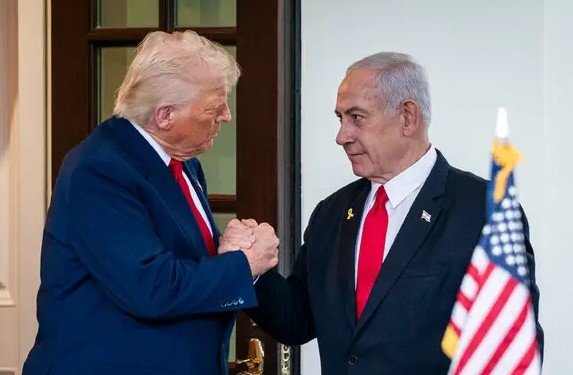
The call took place while Trump was meeting Benjamin Netanyahu and an Israeli delegation at Trump’s Mar-a-Lago residence in Florida. Netanyahu reportedly held the phone up so Trump could hear Kisch’s remarks clearly.
Kisch described the decision as “historic,” telling Trump that the prize committee had chosen him for a “special contribution to the Jewish people.”
The words were formal, but the moment was unmistakably political.
What the Israel Prize represents
The Israel Prize is widely regarded as the country’s top civilian honor. It is usually awarded to Israeli citizens who have made major contributions in fields such as science, culture, education, and public service.
This time, the category itself was framed differently.
According to Kisch, the committee created a special classification meant to recognize individuals whose actions have had a lasting impact on the Jewish people in Israel and beyond. Trump, he said, fit that definition.
It’s rare, but not entirely without precedent.
Officials suggested this is the first time since Israel’s founding that a non-Israeli citizen is being honored in this specific category, though historians quickly noted that non-citizens have received the prize before.
In 1991, Indian conductor Zubin Mehta was awarded the Israel Prize for his long leadership of the Israel Philharmonic Orchestra.
That detail hasn’t slowed the political momentum of the current decision.
Why Trump is being honored
Supporters of the move point to Trump’s record during his presidency.
They cite his recognition of Jerusalem as Israel’s capital, the relocation of the US embassy, recognition of Israeli sovereignty over the Golan Heights, and his administration’s close alignment with Netanyahu’s government.
For many on Israel’s right, those actions reshaped the US-Israel relationship in tangible ways.
Kisch told Trump that the award reflects his “significant and consistent efforts” on behalf of the Jewish people. That phrasing matters. It places the honor less in diplomacy and more in identity and historic alignment.
Critics, however, see it differently.
Political praise meets political controversy
The decision lands in familiar territory for Trump. Praise from allies. Criticism from opponents. Little middle ground.
Some Israeli commentators argue that awarding the Israel Prize to a foreign political figure risks blurring the line between national honor and partisan gratitude.
Others say the prize has always reflected the values of those awarding it, and that Trump’s policies undeniably shifted Israel’s strategic position during his term.
In the US, reactions have also split along predictable lines. Supporters frame the award as overdue recognition. Critics see it as political theater.
One former Israeli diplomat put it bluntly: honors are never neutral.
Netanyahu’s role and the timing
The timing is hard to ignore.
Netanyahu’s meeting with Trump in Florida came amid ongoing diplomatic efforts and regional tension. Announcing the award during that meeting gave it maximum visibility.
Netanyahu did not formally announce the prize himself, but his presence during the call sent a message of endorsement.
For Netanyahu, Trump remains a valuable ally. Publicly honoring him reinforces that bond and signals continuity in political alignment, regardless of shifting governments elsewhere.
The ceremony itself is expected to take place in April, though final details have not yet been released.
Reactions inside Israel’s public sphere
Inside Israel, the announcement sparked fast reactions across media and political circles.
Supporters highlighted Trump’s policies and called the award justified. Detractors questioned whether the Israel Prize should be linked so closely to current political figures, especially non-Israelis.
Academics and cultural figures also weighed in, some expressing concern that the prize’s traditional focus on scholarship and culture is being stretched.
Others dismissed those concerns, saying the prize has always evolved with the country’s priorities.
One sentence appeared again and again in editorials: this says as much about Israel today as it does about Trump.
A symbolic award with lasting echoes
Whether one views the decision as recognition or provocation, the symbolism is clear.
The Israel Prize is meant to reflect national values. Awarding it to Trump ties those values, at least in part, to his legacy.
That legacy is praised fiercely by some and rejected just as fiercely by others. Which means the debate is unlikely to fade before April.
For now, the phone call has been made, the invitation extended, and the spotlight fixed.
And as with many things involving Trump and Netanyahu, the reaction may end up mattering almost as much as the act itself.