For decades, Arab normalisation with Israel has been presented as a pragmatic route to calm, stability, and eventual justice for Palestinians. The record, however, tells a harsher story. Each major normalisation step has coincided not with restraint, but with deeper territorial entrenchment, regional imbalance, and fewer consequences for Israeli actions on the ground.
What is marketed as diplomacy has repeatedly functioned as insulation.
Normalisation as strategy, not reconciliation
From Washington’s point of view, normalisation has rarely been about resolving the Palestinian question. It has been about sidelining it.
The policy goal has been simple. Draw Arab states into formal relations with Israel, reduce the cost of occupation, and leave Palestinians increasingly isolated. Over time, external pressure fades, leverage disappears, and the status quo hardens.
This approach did not begin with the Abraham Accords.
It traces back to the early 1990s, when the Palestine Liberation Organization signed the Oslo I Accord in 1993. That agreement reshaped Palestinian politics, turning a liberation movement into an authority tasked with policing its own people under Israeli control.
Containment replaced confrontation.
The expectation was that resistance would wither once Palestinians were boxed in administratively and diplomatically. It didn’t.
Oslo’s legacy still shapes the present
The Oslo framework fragmented Palestinian territory, divided authority, and outsourced security coordination. Israeli settlement building did not slow. It accelerated.
During the years following Oslo, the number of settlers in the occupied West Bank and East Jerusalem more than doubled. Negotiations continued. Colonisation deepened.
The lesson was not subtle.
Israel learned it could expand while talking peace. International actors learned they could praise “process” while ignoring outcomes. Palestinians learned that agreements did not translate into freedom.
That pattern set the stage for what came next.
Abraham Accords and the removal of consequences
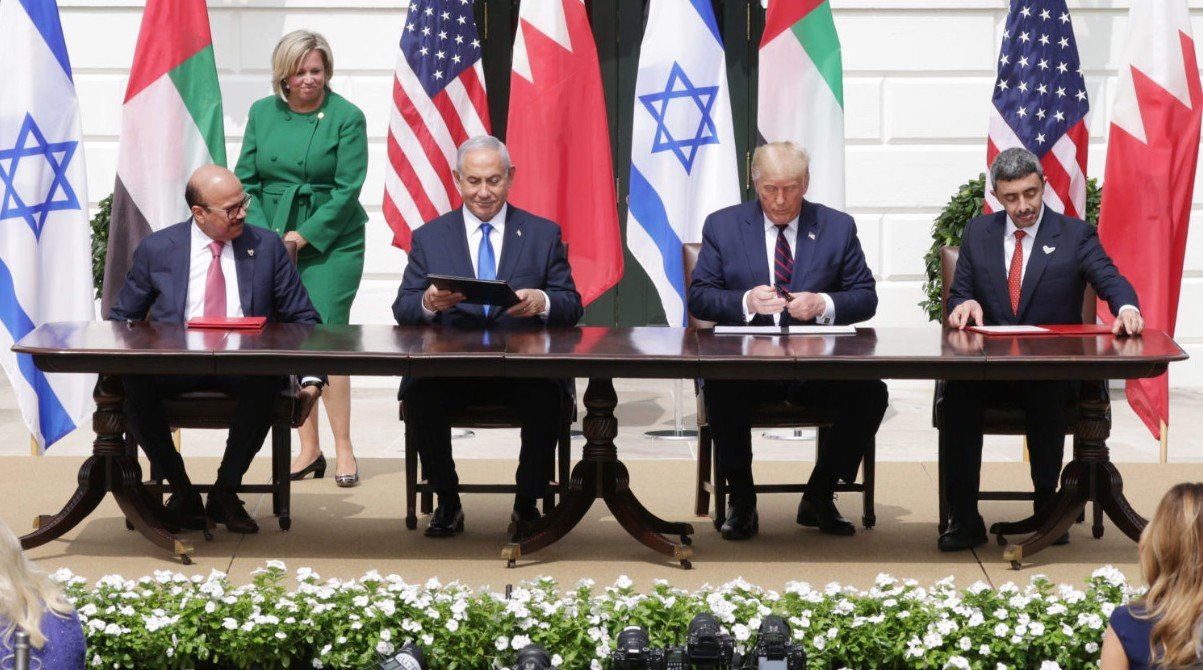
The Abraham Accords, announced in 2020, took normalisation further. The United Arab Emirates, Bahrain, Morocco, and Sudan established ties with Israel without any binding requirement to end occupation or halt settlement growth.
Palestine was no longer even nominally central.
Israeli officials were explicit. Normalisation would proceed regardless of Palestinian objections. The message landed clearly in Jerusalem: regional acceptance no longer depended on concessions.
Since the accords:
-
Settlement approvals have surged in the West Bank
-
Home demolitions have increased
-
De facto annexation policies have advanced under legal cover
Diplomacy continued. Expansion continued faster.
Gaza and the collapse of the peace narrative
The assault on Gaza following October 2023 shattered remaining illusions.
Despite unprecedented destruction and civilian casualties, Israel faced limited diplomatic fallout from its Arab partners. Embassies remained open. Trade continued. Security ties held.
Some initiatives paused. Few reversed.
Saudi Arabia slowed its own normalisation talks, but did not abandon the framework. Libya’s foreign minister secretly met her Israeli counterpart in 2023 before public outrage forced her suspension. Even amid mass death, the direction of travel remained intact.
The signal was unmistakable. Normalisation was resilient. Palestinian lives were not.
Expansion beyond the Arab world
Normalisation has now moved beyond Arab states entirely.
The Trump administration promoted Kazakhstan’s accession to the accords, despite the country already maintaining diplomatic relations with Israel. The goal was symbolic momentum, not substance.
Indonesia, the world’s largest Muslim-majority country, has also been reported to be weighing steps toward formal ties.
These countries were never at war with Israel. Their inclusion serves one purpose: to reframe Israel’s regional position as settled and uncontested, regardless of what happens in Palestine.
The wider the circle of recognition, the weaker the pressure.
Colonisation thrives in diplomatic quiet
Israeli settlement growth has always responded to political conditions. When pressure rises, expansion slows. When scrutiny fades, it accelerates.
Normalisation creates diplomatic quiet.
Arab states that once raised the Palestinian issue in international forums now temper criticism to preserve bilateral ties. Economic partnerships generate vested interests. Security cooperation creates silence.
In that environment, Israel faces fewer risks in pushing boundaries.
Land seizures become administrative acts. Outposts become neighbourhoods. Temporary measures become permanent facts.
Colonisation does not need applause. It only needs absence of resistance.
The Palestinian position weakens by design
Normalisation systematically removes tools Palestinians once relied on.
Arab diplomatic backing shrinks. Economic leverage disappears. Regional boycotts evaporate. International forums lose urgency.
Meanwhile, Israel gains legitimacy without altering policies.
This asymmetry is not accidental. It is the architecture of the strategy.
The claim that normalisation strengthens “moderates” inside Israel has failed every test. Governments most welcomed by Arab partners have overseen some of the most aggressive settlement drives in decades.
What moderation was meant to emerge never arrived.
A regional order built on exclusion
Normalisation also reshapes the region itself.
It creates alliances that exclude Palestinians while binding Arab security interests to Israeli military doctrine. Intelligence sharing grows. Surveillance cooperation expands. Arms deals multiply.
The Palestinian issue shifts from central cause to background noise.
That shift carries a cost.
Regional instability does not disappear when injustice is managed rather than addressed. It simmers. It mutates. It returns in unexpected ways, often violently.
History in the Middle East offers plenty of examples.
Why the promise keeps failing
Supporters of normalisation often argue that engagement creates leverage. The evidence suggests the opposite.
Leverage requires conditions. Normalisation removed them.
Without red lines, recognition becomes a reward for permanence, not change. Occupation becomes normalized. Colonisation becomes background.
Peace rhetoric survives. Peace itself does not.
The uncomfortable conclusion
Arab normalisation with Israel has not restrained colonisation. It has coincided with its most confident phase.
That does not mean diplomacy is futile. It means diplomacy without accountability serves the stronger party.
As long as recognition comes without cost, expansion remains rational. As long as Palestinians are treated as an obstacle rather than a people, stability remains temporary.