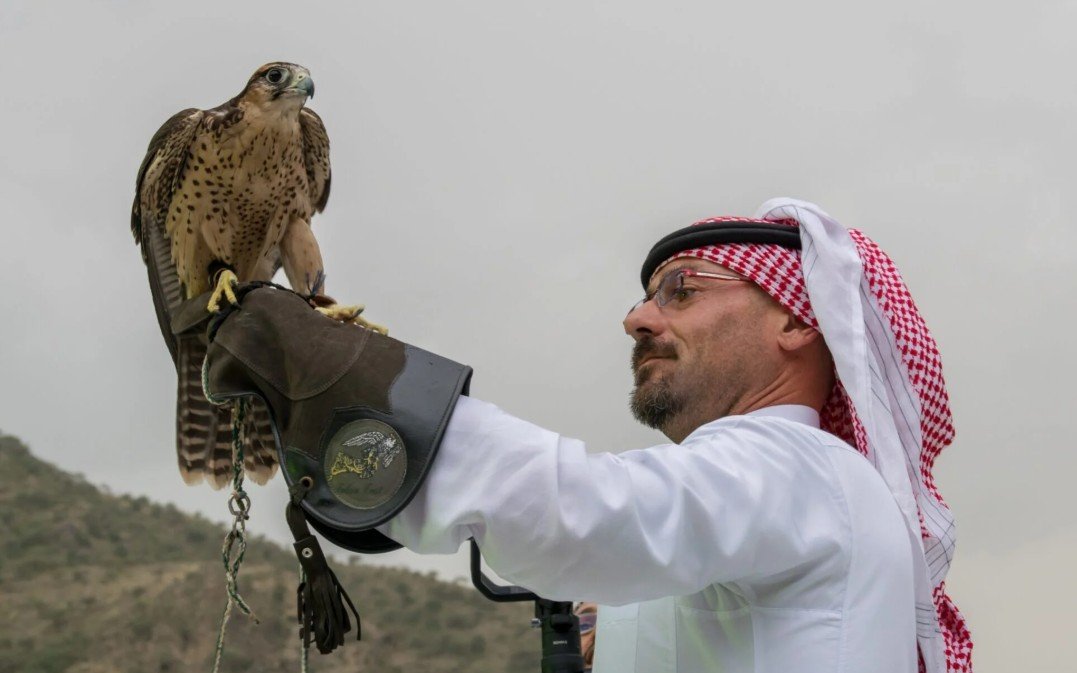
Saudi Arabia has once again turned falconry into a global spectacle. The King Abdulaziz Falconry Festival 2025 opened north of Riyadh this week, drawing falconers from nine countries and putting tens of millions of riyals in prize money on the line as one of the Kingdom’s most distinctive cultural events returned at full scale.
Running from December 25 through January 10, the festival blends deep-rooted tradition with high-stakes competition, all played out at the Saudi Falcons Club headquarters in Malham.
A major opening for a flagship cultural event
The festival launched on Thursday under the banner of the Saudi Falcons Club, which organizes and oversees the event each year. From the first day, competition was front and center.
Six qualifying rounds were held immediately for elite Saudi participants, covering several falcon categories. These included Pure Gyr, Gyr Hybrid, and Saker falcons, each split between juvenile and mature birds.
The early rounds set the tone. Fast. Competitive. Precise.
Handlers watched closely as falcons tore down the course, every fraction of a second counting. For many participants, qualifying alone is a mark of prestige.
For others, it’s just the beginning.
Competition scale measured in numbers and nerves
By the time the festival concludes in January, organizers expect a total of 139 competition rounds to be completed. That scale places it comfortably among the largest falconry events anywhere in the world.
Prize money is equally striking.
Across the festival, 1,012 prizes are on offer with a combined value exceeding SAR 38 million. The awards are split across two main competitions that test very different aspects of falconry skill.
One is about speed. The other is about form.
Together, they define the modern sport.
Al-Melwah tests speed, timing, and control
Al-Melwah, the 400-meter lure race, is where adrenaline takes over. Falcons sprint down the course chasing a mechanical lure, guided by instinct, training, and razor-sharp reflexes.
The competition is divided into multiple tracks, including categories for:
-
Owners
-
Amateur falconers
-
Professional handlers
-
Elite competitors
There are also dedicated rounds for international participants, reflecting the festival’s growing global profile.
Margins here are slim. A slight delay at launch, a misjudged angle, or a moment’s distraction can end a run instantly. Success depends as much on the handler’s preparation as the bird’s raw ability.
Spectators tend to hold their breath during these races. They don’t last long, but they leave an impression.
Al-Mazayen shifts focus to beauty and standards
Al-Mazayen, by contrast, slows things down.
This competition centers on falcon aesthetics, judged according to specific criteria that assess symmetry, feather quality, head shape, and overall presence. It’s meticulous work, though judges rarely use that word.
Each bird is examined closely.
Falconers from across the region and beyond enter Al-Mazayen, often after months of preparation. The contest attracts participants who see falconry as an art as much as a sport.
For many families, winning in Al-Mazayen carries a status that lasts well beyond the festival itself.
International participation continues to grow
This year’s edition brings together falconers from nine countries. Participants from the Gulf Cooperation Council form the largest contingent, but the field also includes competitors from Italy, Ireland, and Syria.
That mix matters.
Falconry traditions vary by region, from training methods to breeding preferences. The festival has increasingly become a meeting point where those differences are exchanged, compared, and, sometimes, blended.
In previous years, the event earned three Guinness World Records for the number of participating falcons, cementing its claim as the world’s largest falconry festival.
Organizers clearly want to keep that reputation intact.
New rounds and younger audiences take priority
Speaking during the opening, Saudi Falcons Club spokesperson Waleed Al-Taweel said the festival places special emphasis on involving future generations.
Dedicated rounds have been created for children and women, alongside a schools category designed to introduce falconry in a structured and accessible way.
The idea is preservation through participation.
This year also introduces new specialized rounds, including the Nova Falcon category and another focused on Mongolian falcons. These additions reflect efforts to diversify competition formats while showcasing different falcon lineages.
It’s an attempt to keep the sport evolving without losing its roots.
Beyond competition, a full-scale cultural showcase
While the contests draw the headlines, the festival is more than a race track.
Visitors can explore exhibitions featuring falconry equipment, breeding tools, and heritage displays. Sponsor pavilions line the grounds, alongside showcases for productive families offering traditional goods.
One of the most active areas is the “Future Falconer” zone. Designed for children, it blends education with hands-on interaction, introducing young visitors to falcon care, training basics, and outdoor activities tied to the sport’s history.
The festival grounds are open daily from 8 a.m. to 5 p.m., and attendance has steadily increased with each edition.
Families, tourists, and international guests move between arenas, exhibitions, and shaded rest areas, creating an atmosphere that feels part sporting event, part cultural fair.
Falconry as heritage and soft power
Falconry holds a special place in Saudi culture, rooted in survival traditions from the Arabian Peninsula. In recent years, it has also become a tool of cultural diplomacy.
By hosting an event of this scale, Saudi Arabia positions falconry as both heritage and modern sport. The prize money signals seriousness. The international invitations signal openness.