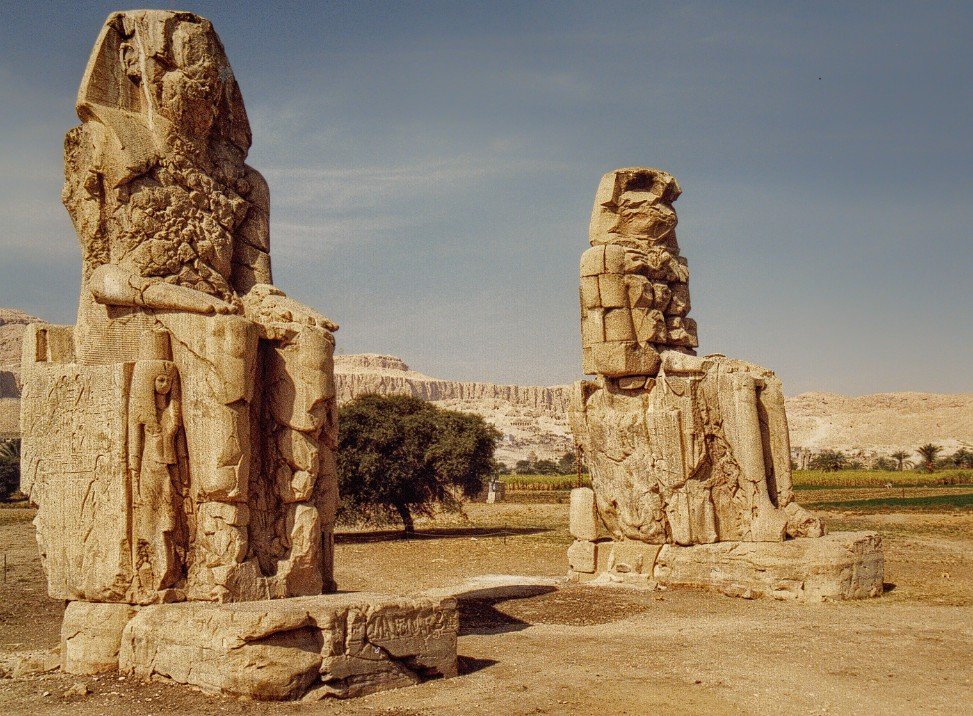
Two immense stone figures that once lay broken and weathered on Egypt’s west bank are standing tall again. In Luxor, the restored Colossi of Memnon have been formally unveiled, closing a restoration effort that stretched nearly 20 years and renewing focus on one of ancient Egypt’s most iconic landmarks.
The statues, which depict Pharaoh Amenhotep III, now offer visitors a clearer sense of scale, presence, and intent than at any point in centuries.
A landmark reclaimed on the west bank of the Nile
The Colossi of Memnon stand on the western edge of the Nile opposite modern Luxor, where temples and tombs once marked the sacred landscape of ancient Thebes.
Each statue towers roughly 18 meters high and weighs hundreds of tons. For generations, they stood fractured and partially collapsed, their surfaces scarred by earthquakes, floods, and human reuse of stone. Today, they once again resemble guardians rather than ruins.
Officials from Egypt’s Ministry of Tourism and Antiquities say the restoration was meant to stabilize what remained and visually reconnect the statues with the vast funerary temple that once surrounded them.
It is not about making them look new. It is about making them legible.
Damage that began more than 3,000 years ago
The destruction of the Colossi did not happen all at once.
According to Mohamed Ismail, secretary-general of the Supreme Council of Antiquities, a major earthquake around 1200 BC caused the most serious damage. The tremor toppled sections of the statues and wiped out much of Amenhotep III’s mortuary temple.
What followed was a slow dismantling by time.
Stone blocks from the collapsed pedestals were scattered across the site. Some were reused in later construction projects, including parts of the Karnak temple complex several kilometers away. Wind erosion and Nile flooding further weakened exposed surfaces.
By the time modern archaeology took interest, the Colossi were famous, but incomplete.
Restoration teams spent years cataloging fragments, tracing their original placement, and studying stress points in the stone before any physical reassembly began.
Progress came in stages, sometimes painfully slow.
Reassembling giants piece by piece
The restoration involved far more than stacking stones.
Engineers and archaeologists worked side by side, testing materials, reinforcing foundations, and carefully repositioning recovered blocks. Each fragment had to match structurally and visually, or it stayed out.
The goal was stability first, appearance second.
One senior conservator involved in the project said the team rejected shortcuts early on. Any misalignment could cause cracks decades later. That risk was not acceptable.
A simplified breakdown of the work shows how layered the process was:
| Phase | Focus |
|---|---|
| Documentation | Mapping fragments and surface damage |
| Recovery | Retrieving blocks from nearby sites |
| Conservation | Treating stone against erosion |
| Structural work | Reinforcing bases and load points |
| Reassembly | Returning original elements to position |
Some original pieces remain missing, and that absence is intentional. Modern additions were kept minimal to preserve historical honesty.
You can still see where time took its toll.
Amenhotep III, frozen in stone
The statues portray Pharaoh Amenhotep III seated upright, hands resting flat on his thighs, posture calm and assured.
Their faces look east, aligned with the rising sun and the Nile, a direction tied to renewal and divine order in ancient belief. Each figure wears the nemes headdress crowned with the double crown of Upper and Lower Egypt, signaling unified rule.
At the pharaoh’s feet are smaller figures of Queen Tiye, his chief wife.
That detail matters.
Queen Tiye held unusual influence during Amenhotep III’s reign, and her inclusion at such scale was a statement of status, not decoration. It reminds visitors that power in this period was shared more openly than many assume.
Amenhotep III ruled from roughly 1390 to 1353 BC, during a high point of Egypt’s New Kingdom. Trade flourished. Art became more expressive. Monument building reached levels few periods could match.
The Colossi were once just the entrance markers to a temple complex that rivaled Karnak in size.
A site that once sang
The Colossi of Memnon are tied to one of antiquity’s most curious legends.
After the earthquake damage, ancient writers reported that one of the statues produced a sound at dawn, a kind of metallic hum or cry. Greek travelers linked the phenomenon to Memnon, a mythical hero slain in the Trojan War, believing the statue greeted his mother each morning.
Roman emperors visited to hear it. Poets wrote about it. Inscriptions were carved by those who claimed they listened.
The sound likely came from temperature changes causing fractured stone to expand and contract. When Roman repairs sealed the cracks, the “voice” fell silent.
Today, the statues no longer sing.
Still, their silence carries weight.
Tourism, identity, and a long view
Egypt’s decision to highlight the Colossi restoration reflects a wider effort to protect and present its ancient sites more clearly.
Luxor remains one of the country’s most visited destinations, drawing millions annually. Officials say improved conservation helps manage that attention while preserving monuments for future generations.
The restored Colossi also shift how visitors experience the area.
Instead of passing by broken giants on the way to other sites, travelers now stop, linger, and look longer. Guides can explain not just who Amenhotep III was, but why scale and placement mattered so much.
According to the ministry, the project also trained a new generation of Egyptian conservators, creating local expertise rather than relying entirely on foreign missions.
That knowledge stays.
What visitors notice now
Standing before the Colossi today, several changes stand out.
-
The statues appear more balanced and grounded
-
Decorative details are easier to read
-
The original footprint of the temple feels more real
There is still damage. Cracks remain visible. Surfaces are worn. That honesty gives the site credibility.
As one Luxor-based guide put it, “They look old again, but in a good way.”
A reminder carved in stone
The restoration of the Colossi of Memnon does not rewrite history. It steadies it.
These statues have endured earthquakes, floods, stone thieves, colonial fascination, and modern crowds. Their survival feels less like triumph and more like persistence.
For Egypt, unveiling them again is a statement. Heritage is not static. It needs attention, patience, and time.
After nearly two decades of work, the giants are upright once more, watching the Nile as they have for over 3,000 years.