
Washington expects Israel to fund and oversee debris removal across Gaza as a first step toward rebuilding, a move that could lock Jerusalem into years of costly, politically fraught work
Israel has quietly agreed to a key American demand that could reshape the next phase of Gaza’s postwar reality: paying for and managing the massive operation to clear rubble left behind by more than two years of fighting, according to Israeli media reports.
The decision, conveyed to Jerusalem by Washington and accepted in principle, would place Israel at the center of an enormous engineering and financial effort, one that officials say could exceed $1 billion and stretch on for years before meaningful reconstruction even begins.
A US demand that changes the postwar equation
According to a report by Ynet, US officials have made it clear that debris removal across Gaza is Israel’s responsibility under emerging postwar arrangements. The logic from Washington is blunt. Reconstruction cannot start while cities remain buried under concrete, twisted steel and unexploded remnants of war.
Israel, the report said, has agreed “for now” to the request.
A senior Israeli official cited by Ynet confirmed that Jerusalem accepted the American position, at least at the initial stage. The first step would be a limited pilot program in Rafah, the southern Gaza city currently under Israeli military control.
That test phase would involve clearing rubble from a single neighborhood.
Even that, officials warned, would be expensive.
One sentence captures the scale: tens, possibly hundreds, of millions of shekels for just one area.
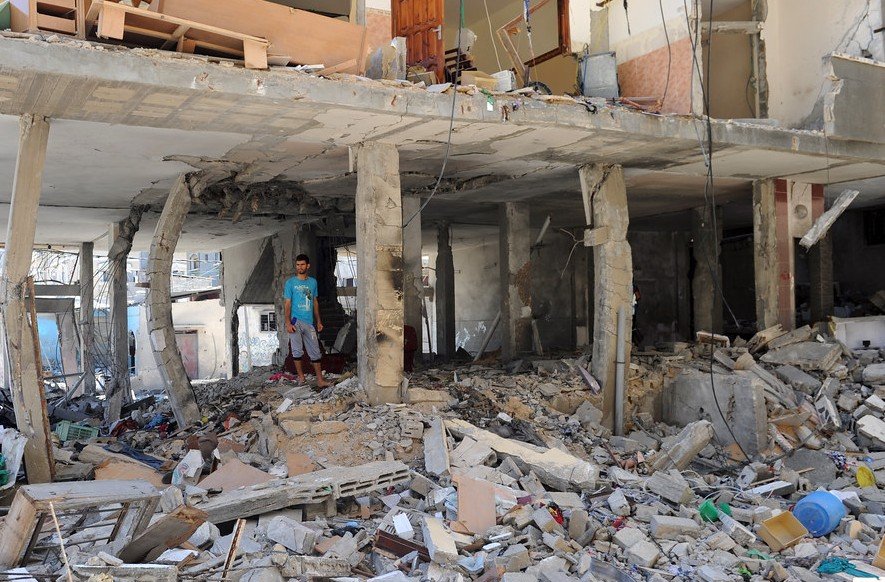
A war that left Gaza in ruins
The task ahead reflects the scale of devastation in Gaza since the war erupted after Hamas’s October 7, 2023 attack on southern Israel, which killed about 1,200 people and saw 251 hostages taken.
Israel’s military response, aimed at dismantling Hamas’s governing and military capabilities, has reshaped the enclave’s physical landscape. Airstrikes, artillery fire, and ground fighting reduced entire districts to piles of debris.
Satellite imagery analyzed by the United Nations paints a stark picture.
According to data cited by The Wall Street Journal, more than 123,000 buildings have been destroyed and another 75,000 damaged. Roughly 81% of Gaza’s structures are either ruined or structurally compromised.
In plain terms, most of Gaza is uninhabitable.
Clearing that destruction is not a clean-up job. It is a massive civil engineering operation, complicated by unexploded ordnance, unstable structures, and dense urban layouts.
Why Israel may end up footing the bill alone
One of the most striking elements of the report is who is not expected to pay.
Arab states and international donors have so far shown little appetite to fund debris removal itself. Diplomatic discussions have focused more on future rebuilding, governance frameworks, and humanitarian aid than on the unglamorous work of clearing rubble.
That reluctance leaves Israel exposed.
If no external funding materializes, Israeli officials acknowledge that Jerusalem could be left responsible for clearing much, if not all, of the Strip. That would mean Israeli oversight of contractors, logistics, disposal sites, and safety protocols across a hostile, densely populated territory.
And the costs would climb fast.
One Israeli official said privately that rubble clearance could easily surpass $1 billion before a single new building rises.
Rafah as a test case, and a warning
The pilot project in Rafah is meant to answer practical questions before any wider rollout.
How long does it take to clear one neighborhood.
How dangerous is the unexploded material.
How much does each square kilometer really cost.
Those answers will shape the rest of the plan.
But Rafah also carries political weight. It sits along the Egyptian border, an area already fraught with diplomatic tension. Any Israeli-led operation there will be closely watched by Cairo, Washington, and humanitarian agencies.
A single misstep could freeze progress.
One short paragraph says it plainly: Rafah is not just a construction site. It’s a pressure point.
What rubble removal actually involves
Rubble clearing in Gaza is not a matter of bulldozers and trucks alone. According to engineers familiar with post-conflict zones, the process unfolds in stages, each expensive and slow:
-
Surveying areas for unexploded bombs and unstable structures
-
Controlled demolition of partially standing buildings
-
Sorting debris to separate hazardous waste, metals, and concrete
-
Transporting millions of tons of material to disposal or recycling sites
Each step requires specialized equipment and trained crews.
And Gaza’s density makes everything harder.
Unlike rural war zones, Gaza’s neighborhoods are packed tight. Collapsed buildings lean on one another. Roads are narrow or blocked. Utilities lie shattered beneath the rubble.
Every move carries risk.
Political costs rival financial ones
Beyond the money, the optics are tricky.
Israel overseeing rubble removal in Gaza blurs lines between military control and civil administration, even if officials insist the goal is purely technical. Critics inside Israel warn that the arrangement could deepen international expectations that Israel will manage Gaza’s recovery indefinitely.
Some lawmakers question why Israel should pay for destruction caused during a war triggered by Hamas.
Others argue that refusing would isolate Israel diplomatically, especially with Washington.
The US pressure reflects a broader American effort to shape a postwar order that avoids a humanitarian collapse while keeping Hamas sidelined. For Washington, rubble clearance is a prerequisite, not a favor.
Israel, facing limited alternatives, appears to have accepted that logic.
Reconstruction still far away
Even if rubble removal proceeds smoothly, rebuilding Gaza remains a distant prospect.
No agreed governance structure exists for the enclave once fighting fully subsides. Hamas’s future role remains unresolved. The Palestinian Authority has not secured regional backing to return. Donor states want clarity before committing funds.
That means Israel could spend years clearing debris without seeing cranes rise or neighborhoods restored.
One Israeli official described the situation as “paying the entry fee to a room we haven’t even opened yet.”
It’s a vivid image, and an uncomfortable one.
A project measured in years, not months
Experts caution that expectations should be modest.
Based on similar postwar efforts elsewhere, clearing Gaza’s rubble could take five to ten years, depending on funding, security conditions, and political stability. Delays are likely. Costs tend to rise, not fall.
For Israel, agreeing to Washington’s demand may ease short-term diplomatic pressure. But it locks the country into a long-term commitment with no clear endpoint.
