
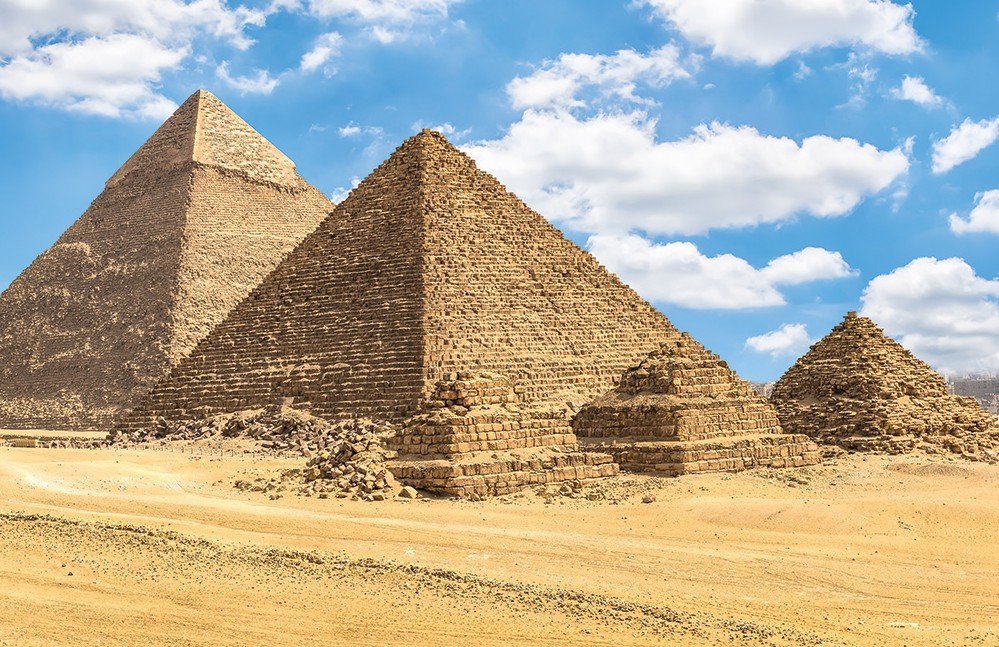
A fresh wave of excitement and controversy has swept across Egyptology after Italian scientists announced satellite-based radar data pointing to a massive underground complex beneath the Pyramid of Khafre in Giza. The claim has reopened debates about hidden structures under Egypt’s most iconic monuments.
Researchers say their tomographic readings reveal shafts, chambers, and sloped tunnels descending roughly 3,500 feet below the plateau. The prospect sounds almost unbelievable, yet it has captured global attention and stirred strong reactions throughout the archaeological community.
Scientists Present a Bold Interpretation
Italian researchers Roberto Malanga and Biondi shared their findings during a press briefing, calling the results a major breakthrough for structural analysis. Their team used Synthetic Aperture Radar and Doppler signal techniques derived from stone vibration mapping. They say the technology allowed them to build layered 3D images, almost like a medical scan of the earth.
Two short sentences and then switch. The scientists claim that the recorded anomalies do not resemble natural geological patterns. According to them, the shapes resemble shafts with cylindrical outlines, stair-like descents, and chambers that seem architecturally deliberate.
One researcher explained that if the images are zoomed in and processed further, the depth and symmetry appear too consistent to be random. That idea alone is fascinating.
A small paragraph in one sentence: Skeptics immediately rejected this interpretation.
Archaeologists say radar cannot accurately penetrate dense limestone to such extreme depths. Traditional Egyptologists noted the enormous distance Malanga cites—almost a kilometer below ground—is unlike anything ever recorded with verified excavation.
-
Researchers insist the geometry of the data signals engineering, not natural fractures.
The bullet point sits neatly in the middle, adding clarity without interrupting flow.
Some experts argue that without boots-on-the-ground excavation, the radar maps remain speculation. That disagreement is creating tension, because one side views the data as compelling, while the other dismisses it outright. The truth is, very few scientific papers have addressed subterranean scanning at that scale, making it harder to judge.
A Long History of Giza Mysteries and Legends
Human imagination has always gravitated toward secret passageways beneath the pyramids. The Giza Plateau has inspired explorers, writers, mystics, and even fringe scientists for more than a century.
One sentence alone: The Italian announcement revived a familiar story.
During the 1930s, American clairvoyant Edgar Cayce shared that an ancient archive lay beneath Giza. He linked it to Atlantis and described a supposed “Hall of Records” containing maps, genealogy, and wisdom predating Pharaonic civilization. Mainstream archaeologists have consistently disagreed. They say there is zero verified evidence showing any chamber containing advanced archives beneath Khafre or Khufu.
Still, the myth refuses to vanish. People love the idea that a massive secret could be buried in plain sight. It feels cinematic, almost like something waiting for its big reveal. Actual excavations around the Sphinx have found voids and cavities before, although most turned out to be natural tensile gaps or small unfinished tunnels, not monumental archives.
Interest spikes every time new technology is introduced. For example, remote muon scans conducted by the ScanPyramids team in 2017 detected several voids within the Great Pyramid of Khufu. The discovery was verified, peer-reviewed, and globally accepted. It proved that internal spaces can exist without written record or historical description. Yet those chambers were far smaller than what Malanga’s group is now suggesting under Khafre.
Two short sentences together: This contrast matters. One discovery had physical excavation and peer review, while the new claim does not.
Some people wonder whether future Egyptian authorities might someday re-examine underground anomalies if enough independent researchers confirm similar patterns. For now, officials remain firm that excavation priorities are tied to evidence backed by physical surveying.
Can Radar Truly Map 3,500 Feet Below Bedrock?
Here, the conversation becomes technical. Malanga’s team insists that satellite-level SAR Doppler tomography can filter ground reflections at extended depth ranges by processing repeated orbital passes. Traditional geologists remain unconvinced, arguing that electromagnetic signals lose stability inside rock.
One sentence alone: That technical disagreement is the heart of the controversy.
To illustrate depth comparisons clearly, here is a small reference table using verified scale data from well-known Egyptian excavations:
| Structure / Excavation Site | Approximate Depth Below Ground | Verification Method |
|---|---|---|
| Khufu internal grand void | 21–40 meters | Muon tomography + peer review |
| Osiris Shaft (Giza) | ~33 meters | Physical exploration |
| Valley Temple tunnels | 10–15 meters | Archaeological excavation |
| Malanga’s Khafre anomaly claim | ~1,050 meters (approx.) | Satellite SAR inference |
This table shows a dramatic difference. Known tunnels barely reach 30 meters below surface. Malanga’s claim pushes the reading more than 1,000 meters deep. That number is what scares archaeologists and electrifies enthusiasts.
Some scientists argue that satellite SAR cannot separate complex rock noise from engineered cavities at such depth. Others say the technology is evolving and might surprise skeptics the same way muon detectors did during the Khufu void discovery. The truth probably lies in needing independent replication by additional labs.
Another one-sentence paragraph: Without physical drilling, the question remains unanswered.
Egyptian officials are unlikely to approve deep excavation unless a broad scientific coalition demands it. Excavation at such enormous depth would require technical infrastructure similar to industrial mining rather than archaeology.
Why This Story Captivates People Anyway
Something about mysteries beneath pyramids triggers a child-like curiosity. The idea combines history, adventure, architecture, and lost-civilization legends into a single emotional narrative that feels irresistible.
One sentence alone: Stories like this give people a sense that ancient builders were far more complicated than textbooks describe.
Even mainstream scholars admit Egypt still holds unknown chambers, unfinished tunnels, forgotten shafts, and sealed tombs. Every large restoration reveals minor features that earlier surveys missed. That reality keeps popular imagination alive. People assume that if small things were overlooked for so long, perhaps something enormous might exist too.
Public fascination also stems from the fact that Egypt has already stunned researchers before. In 2023, archaeologists uncovered a mummification workshop tunnel network at Saqqara, stretching hundreds of meters and never previously documented. It proved that subterranean architecture was more common than some academics expected.
Short paragraph: The past keeps surprising us.
Whether Malanga’s data is revolutionary or mistaken, the emotional response is the same: curiosity.
People will keep watching this conversation, probably for years. Some hope future technologies eventually clarify whether Khafre conceals something astonishing, or whether satellite readings misinterpreted natural fractures.
Egypt’s Ministry of Antiquities has not issued any excavation order tied to the claim. Officials prefer validated discoveries, especially after high-profile international research projects faced criticism for premature announcements. Independent peer review remains the deciding factor before any large-scale investigation occurs.
