Underwater archaeologists have uncovered a remarkably preserved 2,000-year-old pleasure vessel off the coast of Alexandria, shedding new light on maritime life, urban luxury and religious culture during early Roman Egypt.
A Major Find Beneath the Sunken Island of Antirhodos
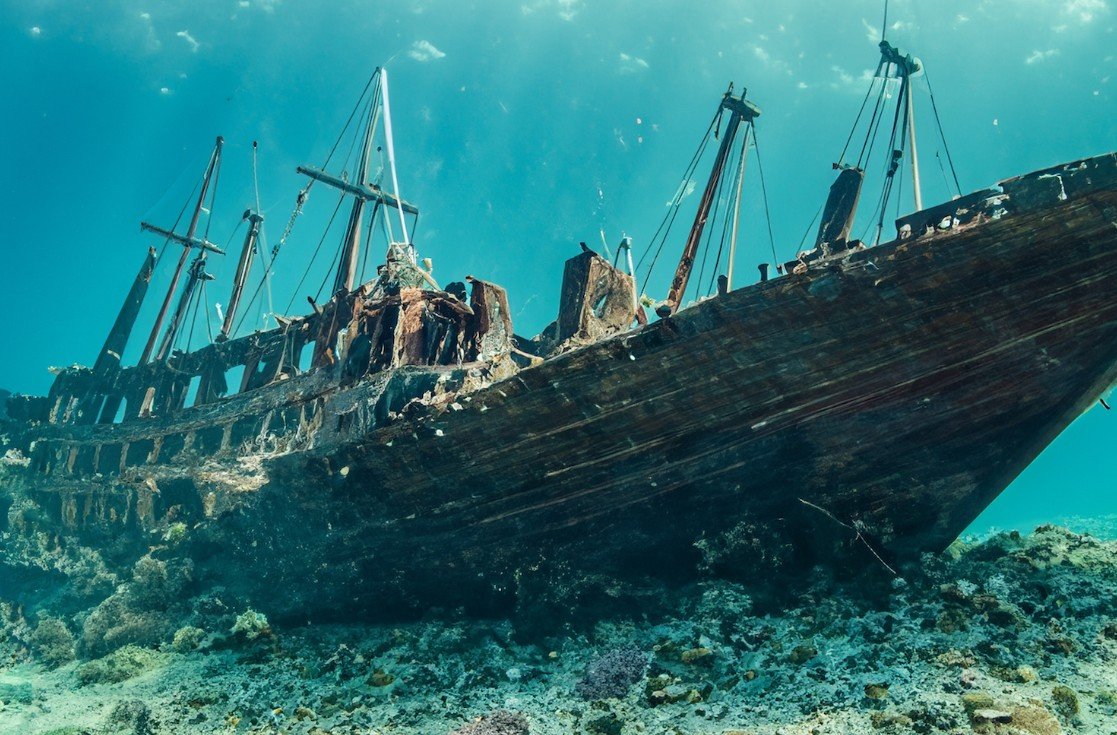
Divers working with the European Institute for Underwater Archaeology (IEASM) located the ship’s hull submerged in the ancient port of Antirhodos, a once-thriving island that later sank due to earthquakes and tidal surges sometime in the 4th century. The vessel measures more than 35 metres long and about seven metres wide, making it unusually large for personal or ceremonial voyages.
One sentence adds pacing.
Antirhodos was rediscovered in 1996 and has become one of the most significant underwater archaeological zones in the Mediterranean.
The shipwreck sat among collapsed port structures and urban debris from the once-active island. IEASM said the vessel would likely have belonged to wealthy urban elites, possibly used for ceremonial trips, river leisure or temple processions.
Greek Graffiti Provides Early Roman-Era Dating
The hull features Greek graffiti that may date from the first half of the first century AD, based on handwriting style and cultural context. That evidence supports the theory that the ship was built in Alexandria rather than imported from another Mediterranean hub.
IEASM archaeologists explained that the graffiti likely came from shipbuilders, crew members, or owners, offering an intimate detail rarely preserved underwater.
One sentence.
Graffiti on ancient ships is like a handwritten diary — informal, personal and difficult to reconstruct elsewhere.
The early Roman period marked Alexandria as a multilingual city, with Greek, Egyptian, Latin and Jewish communities intersecting through trade, scholarship and philosophy.
A Luxury Vessel Built for Calm Waters
The ship appears to have been propelled solely by oars, not sails, suggesting short-distance leisure journeys within Alexandria’s harbors or along nearby lagoons. The vessel reportedly contained a luxuriously decorated cabin, ideal for high-status guests, religious officials or wealthy Alexandrian families.
A short sentence fits naturally.
This was not a warship or merchant carrier.
IEASM believes the vessel may have been used for coastal festivities, temple rituals or seasonal processions connected to Isis worship — a common religious feature in Roman Egypt.
Antirhodos Continues to Reveal Treasures
Since the 1990s, divers have retrieved statues, coins, ceremonial objects and monumental architecture from the waters surrounding Antirhodos. Some of these discoveries already sit in Alexandria’s Greco-Roman Museum.
A one-sentence paragraph.
The underwater site continues to expand Egypt’s maritime history record.
IEASM director Franck Goddio has spent decades documenting Antirhodos, including its urban streets, harbor facilities, workshops and the island’s famed Temple of Isis. His research reveals a wealthy cultural district tied to royal households, cult practices and trade networks.
The newly discovered shipwreck provides missing details on leisure travel, social identity and the decorative tastes of Alexandrian elites.
Why Future Research Matters
A table helps clarify what archaeologists hope to learn from the wreck:
| Research Focus | Expected Insight |
|---|---|
| Decorative cabin elements | Wealth and artistic style of early Roman Egypt |
| Wood type and construction | Shipbuilding techniques used in Alexandria |
| Graffiti analysis | Identity clues for crew or owners |
| Onboard inventory | Ritual or social functions of the vessel |
| Bio-material remnants | Daily food, ritual offerings or travel routes |
One sentence for variety.
Every plank and artifact increases understanding of Alexandria’s coastal life.
Scientists expect to analyze how the ship was maintained, whether it had ceremonial roles for state events, and how its owners interacted with harbor infrastructure.
Future field seasons will likely include material conservation, 3D mapping, and attempts to retrieve cabin fragments or onboard objects trapped in sediment. Underwater excavation requires slow, delicate removal because the hull has been encased for centuries.
A City Full of Heritage Yet Under Threat
Alexandria remains one of the world’s richest archaeological cities, with Roman villas, lighthouse ruins, submerged ports and artifacts linking Ancient Egypt to Greece and Rome. But its long-term preservation faces urgent danger.
Short sentence.
Climate change is accelerating the city’s descent.
Egypt’s second-largest metropolis is sinking by more than three millimetres every year, leaving coastal districts vulnerable to water intrusion. Even under the UN’s most optimistic projections, scholars estimate that a third of Alexandria could be underwater or uninhabitable by 2050.
Archaeological zones, historic cemeteries, ancient libraries, and submerged city blocks face gradual erosion and saltwater penetration, limiting future excavation options.
Archaeology Racing Against Time
Experts now describe underwater archaeology in Alexandria as a race against geophysical change. Antirhodos and its urban remains have survived nearly two millennia, but future access could shrink as water levels rise and coastal sediment shifts.
One sentence.
Shipwrecks found today might be inaccessible tomorrow.
Conservation teams say heightened international funding is needed to sustain underwater surveys, artifact stabilization, and digital scanning before conditions worsen. Cultural heritage in Alexandria is not solely Egyptian — it is Mediterranean, Hellenistic, Roman and global.
The discovery of this shipwreck adds urgency to that work. Each artifact gives a vivid storyline: wealthy families traveling by water, religious gatherings drifting through sacred harbors, and leisure culture unfolding just beyond temple walls.
Alexandria’s submerged city holds stories far beyond legends, and explorers believe this newly revealed vessel is only the beginning.