
Israel is examining partial human remains transferred by Hamas through the Red Cross on Tuesday, in a development that has reopened painful questions about the fate of the final two hostages still held in Gaza under the ceasefire framework.
Officials say the fragments are “small remains, pieces,” and at this stage no authority has confirmed the identity. Still, the handover marked the first movement on hostages in several days — and came as Qatar urged the warring sides to move into the next stage of negotiations “very, very soon.”
A Grim Delivery Raises More Questions Than Answers
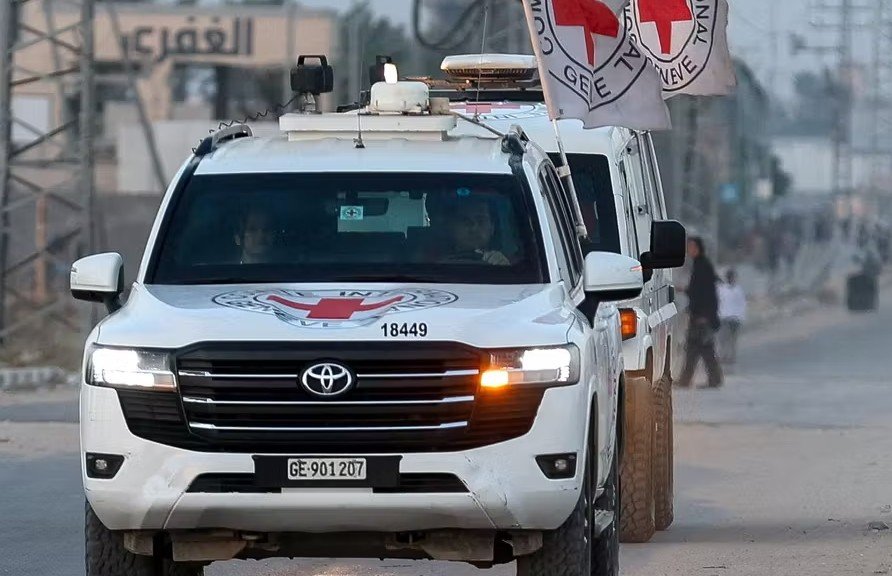
The remains were quietly brought out of Gaza by the International Committee of the Red Cross, then handed to the Israel Defense Forces for an initial inspection.
Just a few sentences, but heavy in tone.
A senior Red Cross official told The Times of Israel that the transfer included only partial fragments. It was unclear whether Hamas intended these to represent one of the two deceased hostages still held in Gaza or whether they belonged to someone else.
One-line paragraph to signal uncertainty.
And for Israel, uncertainty is the most painful part.
The IDF held a short ceremony led by a military rabbi before transferring the remains to the Abu Kabir forensic institute in Tel Aviv, where forensic teams will try to identify them and determine the cause and timing of death.
Palestinian media outlets reported the remains were found in Beit Lahiya in northern Gaza — although that, too, is still unverified.
Hamas Suggests a Handover, But No Formal Announcement
Earlier in the day, a Hamas official told Reuters that the group was providing the Red Cross with the body of a hostage.
But Hamas did not issue any public confirmation.
Israeli officials said the findings handed over did not match a complete body, adding another layer of ambiguity. Two hostages’ bodies are still being held by Hamas: Master Sgt. Ran Gvili and Thai national Sudthisak Rinthalak, both kidnapped on October 7.
One sentence for pacing.
Their families have been waiting for weeks without a clear timeline.
The gradual return of deceased hostages has been one of the most agonizing elements of the US-brokered ceasefire. Over the last seven weeks, Hamas has returned the remains of 26 hostages — often without prior notice, and rarely with an explanation.
Each transfer has stirred new waves of grief inside Israel, as forensic teams and families brace for updates that sometimes come in incomplete, fragmented form.
The Ceasefire’s First Phase Hinges on Hostage Returns
The first phase of the October 9 ceasefire agreement promises the return of all hostages — alive and dead.
It is the core condition anchoring the fragile truce.
Under the US-backed roadmap, later phases would require Hamas to disarm, Israeli troops to withdraw further from Gaza and a transitional governing body — backed by a multinational peacekeeping force — to be installed.
But that stage remains theoretical.
The real work right now is identifying the dead and finding the missing.
One paragraph with a shift.
Israeli officials have grown increasingly uneasy about the pace, fearing Hamas could use the handover of remains as leverage to stretch out negotiations.
The uncertainty has created intense emotional strain across Israel, where hostage families meet regularly with government representatives and press for faster progress.
Qatar Pushes for Momentum in Negotiations
Doha, which has played a central role in mediating the talks, said Tuesday it hopes to move Israel and Hamas into the next phase of the ceasefire negotiations “very, very soon.”
It was a message meant to both reassure and nudge.
Majed al-Ansari, the spokesman for Qatar’s Foreign Ministry, said momentum should not be allowed to stall, especially with outstanding hostage cases unresolved and political pressure rising on all sides.
A one-sentence pause.
But moving forward requires the cooperation of parties who barely trust one another.
Qatar’s diplomats have privately expressed frustration at delays, warning that gaps in communication could allow hardliners — in both Israel and Gaza — to derail the fragile progress made since October.
The remains handed over Tuesday illustrate how delicate the process is. When transfers are partial, incomplete or unclear, they can spark tensions and accusations, even when mediators are trying to move the talks ahead.
Israel’s Forensic and Security Teams Brace for What Comes Next
At the Abu Kabir forensic institute, experts will now examine tissue fragments, bone material and any trace evidence to match DNA samples already collected from hostage families.
It’s precise and emotionally brutal work.
Forensic teams at Abu Kabir are used to high-stakes cases, but the hostage identifications carry an added emotional weight: every update is delivered directly to waiting families under intense media scrutiny.
Another short pause here.
Many of those families attended military briefings this week, hoping for clarity that still hasn’t arrived.
Meanwhile, the IDF continues searching areas in Gaza where intelligence indicates remains may be buried. The slow pace reflects the extent of destruction in northern Gaza and the difficulty of locating material after months of fighting.
The Human Toll Behind the Numbers
The October 7 attacks — in which Hamas-led gunmen killed around 1,200 people and kidnapped 251 — still shape every step of today’s ceasefire mechanics.
The war’s emotional residue remains thick everywhere.
While the public debate often focuses on diplomacy and military strategy, the hostage issue continues to be the beating heart of Israel’s national trauma.
Identifying fragments of remains keeps that trauma raw.
This latest handover does not close a chapter. It simply opens another complex phase of investigation and negotiation, even as mediators push to accelerate talks and ensure the ceasefire doesn’t freeze into uncertainty.
