Egypt pulled the curtain back on its newest deep-strike weapon at EDEX 2025, introducing the Rad’a 300 rocket system — a local answer to long-range launchers like HIMARS and a major step in Egypt’s effort to shape its own firepower.
Officials revealed the system in New Cairo with an air of confidence, framing it as the anchor of a broader artillery vision.
A First Look at a Home-Built Long-Range Launcher
The Rad’a 300 made its debut with the kind of attention usually reserved for headline fighter jets.
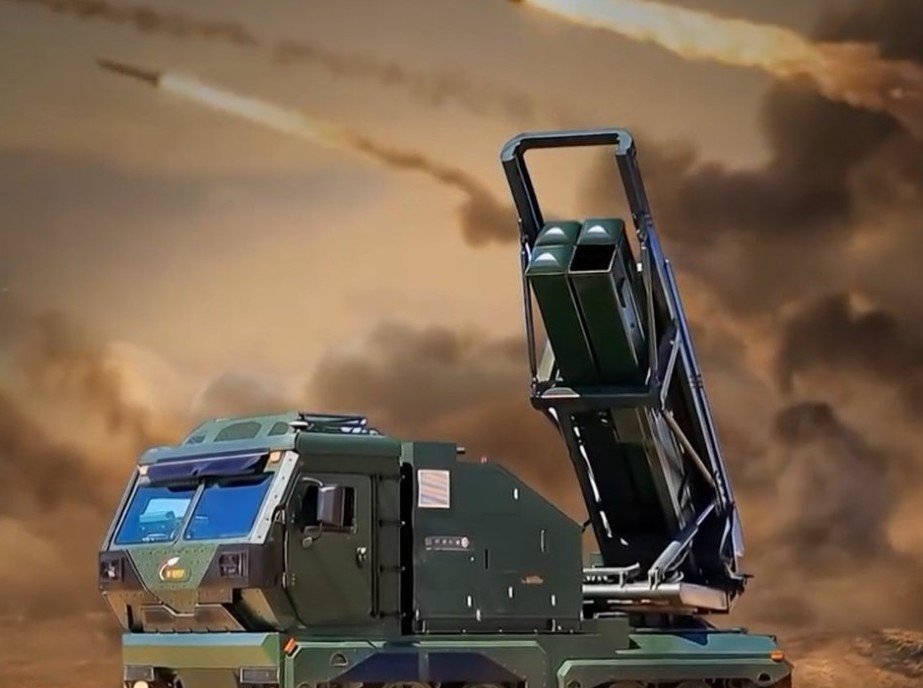
Observers quickly noted its imposing tracked body and sealed launcher pod.
It felt like a message from Egypt: We can build our own heavy hitters now.
Photos from Army Recognition confirmed the vehicle’s podded layout.
They also showed strong hints of the older RAAD 200 design lineage, from the five road wheels on each side to the armored cab up front.
The new launcher trades open tubes for a closed pod that screams modern engineering.
Officials didn’t share many hard numbers.
But they did say the system is tailored for strikes out to roughly 300 km, depending on the rocket fitted.
What Makes the Rad’a 300 Different
People walking the floor at EDEX pointed out something quickly.
This wasn’t just a bigger RAAD 200.
It represented a shift toward pod-based rockets like those used on the American M270 and Chinese AR1A systems.
The sealed pod approach hinted at a few things —
• Faster reloads, less crew exposure, and the ability to swap pods carrying different rocket calibres.
That flexibility matters a lot in Egypt’s environment.
A short paragraph on its own here.
The military has been searching for an adaptable system that fits conventional artillery and longer-reach missions.
Another interesting detail came from the tracked chassis speed.
It can reach around 40 km/h across varied terrain, giving it enough pace to keep up with Egypt’s mechanised units.
How Rad’a 300 Fits Egypt’s Long-Range Strategy
Egypt has been studying rocket systems worldwide for over a decade.
Officials tested, evaluated, and observed foreign platforms in combat.
This shaped the thinking behind the Rad’a 300.
They looked at Ukraine’s Vilkha-M, with its guided 300 mm rockets.
Then Brazil’s Astros II, which can fire the AV-TM 300 cruise missile.
And Chinese systems like the AR1A and the A300 rockets that boast near-300 km strike ranges.
Basically, Egypt wanted something that combined lessons from all these systems without depending fully on any one supplier.
Rad’a 300 appears to be that answer.
Some might call it the next chapter for the RAAD 200 family.
Egypt’s previous tracked launcher fired 122 mm rockets out to about 45 km, and while useful, it couldn’t shape deep battles.
The Rad’a 300 fills that gap decisively.
The Capabilities and Mobility Equation
This system isn’t just about range.
It’s about where it can go, where it can hide, and what it can hit.
One quick sentence here.
Egypt’s desert terrain demands real off-road performance.
The tracked chassis gives that in spades, with better sand mobility than wheeled launchers like HIMARS.
That difference becomes critical in cross-country operations along the Sinai or Western Desert corridors.
Officials said the launcher can be used for precision strikes.
But it can also saturate areas with unguided rockets, depending on the pod chosen.
That’s why experts say the system may end up serving dual roles similar to what HIMARS and Vilkha-M have shown in recent conflicts.
In the middle of this section, a small table comparing range classes was useful to attendees:
| System Name | Maximum Range | Platform Type |
|---|---|---|
| Rad’a 300 | ~300 km | Tracked |
| HIMARS (ATACMS) | 300 km | Wheeled |
| Astros II AV-TM 300 | 300 km | Wheeled |
| AR1A / A300 | 280–285 km | Wheeled |
Egypt’s move to a tracked platform places it closer to the M270 family, which also favors mobility over difficult terrain.
Strategic Impact Across the Region
Here’s where the conversation got heavier.
A launcher like this alters calculations across the Eastern Mediterranean.
With a 300 km envelope, the Rad’a 300 can hit air bases, ports, and logistics hubs far from Egypt’s borders.
That ability changes how planners — friendly or otherwise — think about distance.
The vehicle doesn’t need to cross a frontier to reach key assets.
It can sit deep inside Egyptian territory.
And that means more safety for the crew, plus less vulnerability to counter-battery fire.
One short line here.
A system like this can also respond fast to crises.
Egyptian officials framed the project as part of a wider plan to reduce reliance on imported weapons.
It gives Egypt more control over its stockpiles, especially during regional shortages or political tension.
And as conflicts worldwide have shown, long-range rockets have become essential for shaping the battlefield before soldiers even move.